Strengthening Oyster Shells
Oysters build their shells using a thin tissue called the mantle, which wraps around their body and lines the inside of the shell. The edge of the mantle secretes new shell material. To do this, oysters filter calcium and carbonate out of seawater and combine them into calcium carbonate, which is the same mineral in chalk and limestone. This gets layered on along with a protein framework that adds strength and structure, kind of like rebar in concrete.
Building shell is part of the oyster’s defense against predators. When oysters sense there is a predator near, like a blue crab, they will add shell layers to prevent being eaten. The Smee Lab has spent nearly a decade researching how this defense mechanism can increase the oyster’s survival in the field.
Scaring Oysters Strong
Helping oysters build a stronger, tougher shell starts with understanding predator cues. A predator cue is a chemical signal in the water that warns an oyster a predator is near. These cues often come from a predator’s scent, or from chemicals released when a predator has just crushed another oyster nearby. In response, oysters build thicker, stronger shells, especially around the edge, where predators usually attack. They may grow slower overall, since more energy goes into armor instead of size.
The photo below compares oysters raised with predator cues to those raised without. Induced oysters build thicker, stronger shells, but this investment comes at the expense of body growth. If the predator cue is removed, the induced oysters often catch up in size to those never exposed.
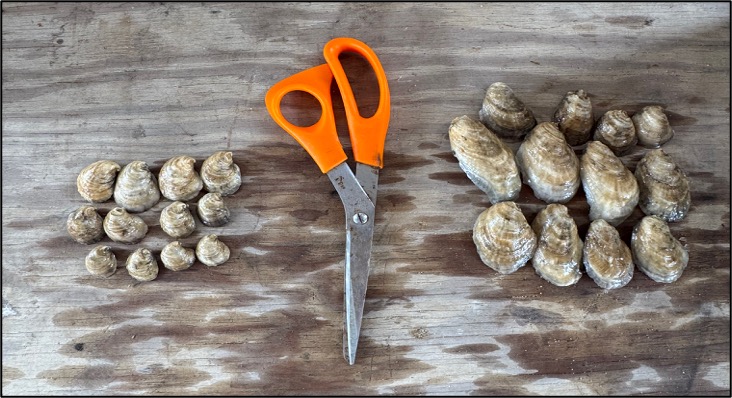
Once the Smee Lab confirmed oysters will build a stronger shell when induced by predator cues, they aimed to identify which molecues within a predator cue signal the oyster to grow a thicker shell. That area of the research is still ongoing.
Related Articles
- Research in Alabama’s Mobile Bay could have value for oyster reef restoration, August 8, 2023, NPR
- Scared Strong, January 8, 2026, Unviersity of South Alabama
- Scaring Oysters Strong, August 5, 2026, Sea Lab Sidebar Podcast
Related Publications
-
Scherer, A.E., Lunt, J., Draper, A.M. and Smee, D.L. (2016), Phenotypic plasticity in oysters (Crassostrea virginica) mediated by chemical signals from predators and injured prey. Invertebr Biol, 135: 97-107. https://doi.org/10.1111/ivb.12120
-
Scherer, A.E., Smee, D.L. A review of predator diet effects on prey defensive responses. Chemoecology 26, 83–100 (2016). https://doi.org/10.1007/s00049-016-0208-y
-
Scherer, A.E., Delbert L. Smee. Eastern Oysters Crassostrea virginica Produce Plastic Morphological Defenses in Response to Crab Predators Despite Resource Limitation. The Biological Bulletin. Volume 233, Issue 2. 2017. Pages 144-150. ISSN 0006-3185. https://doi.org/10.1086/695470.
-
Robinson EM, Lunt J, Marshall CD, Smee DL (2014) Eastern oysters Crassostrea virginica deter crab predators by altering their morphology in response to crab cues. Aquat Biol 20:111-118 https://doi.org/10.3354/ab00549.
-
Scherer et al. (2017), Predatory blue crabs induce stronger nonconsumptive effects in eastern oysters Crassostrea virginica than scavenging blue crabs. PeerJ 5:e3042; https://doi.org/10.7717/peerj.3042.
-
Scherer, A.E., Bird, C.E., McCutcheon, M.R. et al. Two-tiered defense strategy may compensate for predator avoidance costs of an ecosystem engineer. Mar Biol 165, 131 (2018). https://doi.org/10.1007/s00227-018-3391-2.