 Apple Podcasts
 Spotify
 YouTube
 iHeart
Sawfish may be returning to Alabama waters, and new DISL Senior Marine Scientist Dr. Nicole Phillips is using eDNA to find out.
Phillips, who joined DISL in August, explains what a sawfish really is, why the U.S. is the last stronghold for the smalltooth sawfish, and how a water sample can reveal an animal no one has seen.
Museum Specimens Help in Understanding of Sawfish Decline
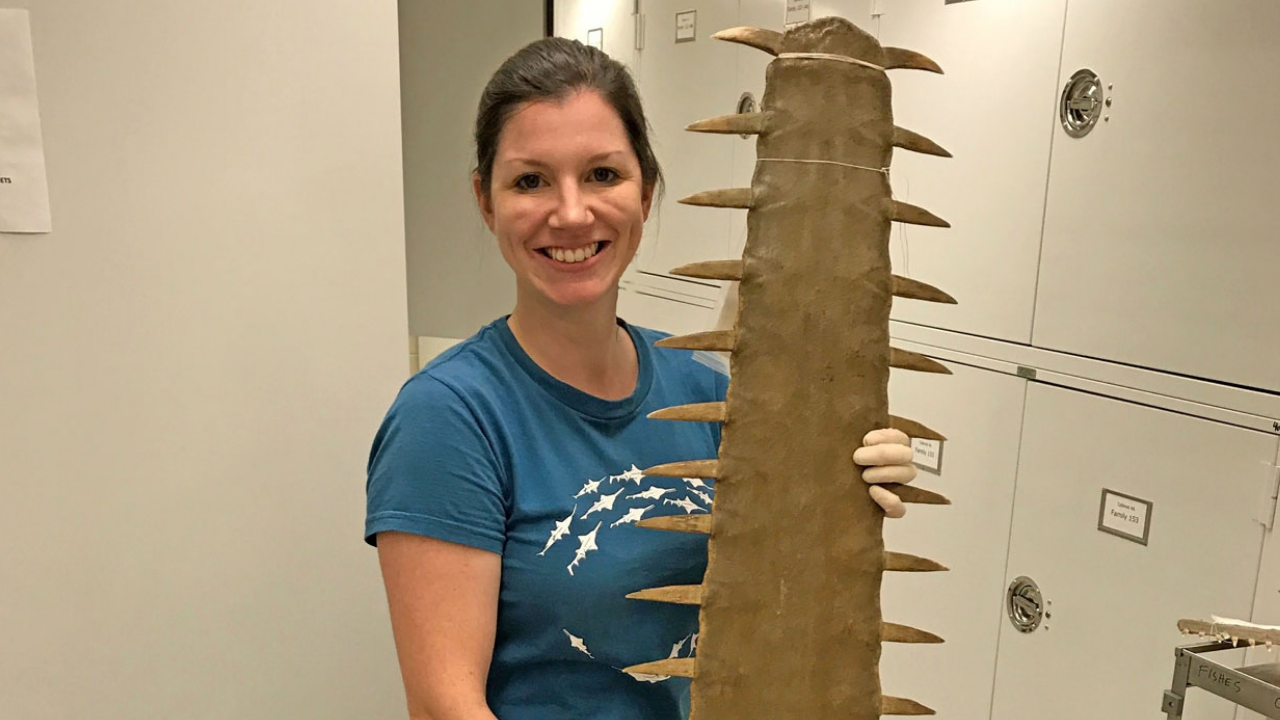
Dr. Phillips was part of a global team of researchers that used museum specimens of largetooth sawfish to understand its history. The team collected tissue from 375 historic sawfish specimens dating back as far as the 1800s.
How Historic Sawfish Collections Changed Conservation
Forbes
August 9, 2026
International Sawfish Day
International Sawfish Day is celebrated October 17 each year. The day aims to raise awareness of these endangered animals and the threats they face.
The website linked above includes posters, brochures, and activities to help spread awareness.
Related Articles
U.S. Sawfish Back on the Brink: Insights and Actions from an Expert Symposium
By Tonya Wiley and Sonja Fordham for Sawfish Conservation Society
Transcript
Angela Levins, DISL PR Director Well, thank you for joining us today on this episode of the Sea Lab Sidebar podcast. Today we are joined by Doctor Nicole Phillips. She is new to the distal community. So Doctor Nicole where are you joining us from.
Dr. Nicole Phillips, DISL Senior Marine Scientist So I am I’ve kind of taken quite a long path. I am originally from Michigan really far from any oceans. Um and then I moved all the way to Australia to study marine science because I was obsessed with sharks since I was about ten years old. And I decided that that was the best place to study them. So I spent ten years in Perth, Australia, and I got my undergraduate degrees and my PhD there. Then I moved back to the United States, and I was a postdoc researcher at NOAA Fisheries in Louisiana. And I’ve been kind of making my way across the Gulf. Because then I was a associate professor at the University of Southern Mississippi. And then just a month ago today, I think I started here at the Dolphin Island Sea Lab.
Levins Wonderful. We are very excited to have you here because you are bringing a new bit of expertise to the Dauphin Island Sea Lab community. We are talking about sawfish. So what is a sawfish?
Phillips A sawfish is a species of ray. So a ray is related to sharks. But if you look at a sawfish, its gills are located on the underside of the body. And that makes it a ray. So it is a cartilaginous fish. So its skeleton is not made out of bones. It’s made out of the same material as, say, our nose or our ears. So what makes a sawfish different from a stingray? Ah. So if you look at a sawfish, it has a shark like body. And that’s why some people do think initially that they are sharks. So they have this sort of elongated body rather than a round body. And the best part about the sawfish is off of its head. It has this rostrum and it’s this long snout that comes off of it. And it is lined on both sides with what we call rostral teeth.
Levins So are those rostral teeth sharp?
Phillips They can be. When the sawfish is first born, they are quite sharp in their early. You know, for the first bit of life until they start using them. Now they are born with a sheath that covers those sharp pointy teeth because sawfish do give live birth. So then over time, you know, they’re using this saw to help stun prey and to defend themselves. And so they’re not, they kind of dull a little bit. And they’re not as sharp as, say, a, a, a tooth in a shark’s mouth, but they can still be pretty, pretty sharp. Um, and if it decides to swing it saw you, it could still, you know, do a little bit of damage
Levins If they were to lose one of their saws, does it grow back or is it just gone?
Phillips It is just gone. Um, a long time ago that there was a misunderstanding where some people did believe that if you cut a sawfish saws off, it would regrow, but that is not the case at all. Once you cut a sawfish’s saw off, it doesn’t have a way to defend itself and it also cannot feed very effectively. Um, and so unfortunately, historically, they did cut a lot of saws off of sawfish. And that’s one of the reasons we saw such a decline globally in Sawfishes is because of that behavior. Um, but that behavior is now prohibited. It is illegal to remove the saw from a sawfish because they are fully protected species. So where do we find them in the world? All over. Um they are found all around the world. There’s five species and they are typically in coastal waters in the tropics and the subtropics.
Levins How about here locally? Where could we possibly spot a sawfish?
Phillips You would be so lucky if you spot a sawfish in the northern Gulf, but it is still possible. So here in the United States, historically, we had two species of sawfish. We had the large tooth and the small tooth. Unfortunately, the large tooth sawfish is believed to have gone extinct. I think the last record was from the nineteen sixties or nineteen seventies. However, the US is the global stronghold for the smalltooth sawfish, so it’s the only place in the entire world that still has decent numbers of small tooth sawfish. Now, mostly they’re found in Florida, around the Everglades, ten thousand islands, Indian River lagoon, Port Charlotte, those areas. But historically they were found in the northern Gulf all the way from all the way from Texas, all the way around to Florida and then up to the Carolinas. Um, they were wiped out mostly from our local region here in Alabama by about the nineteen eighties. But as the population in Florida has recovered, we’re starting to get reports here in the northern Gulf across from Louisiana, Mississippi, Alabama, the Florida Panhandle. Um, and there are some recent reports since twenty twenty in the mobile Bay area and in the Perdido Bay, uh, the Alabama side of the Perdido Bay as well.
Levins So do they migrate?
Phillips So we don’t exactly know what are they doing here and when are they here? That’s some of the research that we want to try to understand because we really don’t have a good handle on, you know, if they’re using these waters ever. When what is it, summer. Is it spring? Summer, fall. How regularly is it? We do know that sawfish migrate up the coast of Florida, but we don’t know how regularly they’re coming up further around the Panhandle and say, over here. And so that’s one of the things that we hope to better understand in, you know, five years, maybe we’ll have a better understanding of what are these animals doing in our water.
Levins And you have a really interesting way that you’re doing this. So you don’t have to put your eyeballs on them. You use what’s known as eDNA or environmental DNA. How does that work?
Phillips So environmental DNA is DNA that’s in the water or in the environment. it can be in the water, in the sediment. Even the air has DNA in it. So all organisms are shedding into their environment. If for humans, you’re shedding cells and hair and, um, that’s how forensics works, you know, like, um, CSI forensics for aquatic species, it’s exactly the same. They’re shedding scales, skin slime. there’s feces in the water. Blood. All of this is going into the environment, and that has DNA from the species. And so when you collect a water sample, you’re also collecting DNA in the water from all the different species that occur there. And so we use this technology to go out, capture the DNA and analyze it in the lab. And one of our main focal areas are sawfish to try to figure out are sawfish here.
Levins Is the DNA in sawfish is going to be the same for each species?
Phillips For the types of analyses we do. Yes. So we actually have to design everything for every species we work on. And when we designed our testing for smalltooth sawfish, we made sure that it would work across all individuals and all populations from everywhere that they used to occur in the world. So you can use this in Africa, or you can use this in the US, and it will still detect smalltooth sawfish. And to, to kind of pinpoint eDNA is a new technology.
Levins About how old is this?
Phillips So the very first, um, eDNA study occurred in tanks as proof of concept in freshwater. And that first study was published in 2008, but it took a long time for this technology to come into the marine system because lakes are a little bit easier right there. Well, most lakes are smaller unless it’s the Great Lakes, but they’re more contained in the DNA isn’t flowing out so fast, but these marine systems are vast. You’ve got currents, you’ve got tides, you’ve got waves. And so I think the first marine use of eDNA actually in the system was somewhere around. I think the first publication was about 2017.
Levins Wow. So we are really we were kind of like on the cusp of, of making some things happen. Well, Doctor Phillips, thank you so much for joining us. International Sawfish Day is October 17. And so we’re super excited to have you on board. And I’m excited to get out in the field with you to see how you do this. And then we’ll come back and tell our listeners what we may have found or what may be there. I’m sure it takes a little bit of time to analyze, but thank you so much for joining us.
Phillips Thank you so much for having me.