 Apple Podcasts
 Spotify
 YouTube
 iHeart
Estuaries are where freshwater from the rivers meets saltwaters from the ocean. Mobile Bay is the fourth largest estuary by volume in the United States. Every single second Mobile Bay empties enough water into the Gulf of America to fill 70% of an entire Olympic-sized swimming pool. The mixing of saltwater and freshwater creates a hot spot for biodiversity.
Our estuaries are economically and environmentally important for many reasons, not the least of which, they serve as a nursery habitat for many commercially and recreationally important fish and shellfish, such as oysters, shrimp, and red snapper.
JoAnn Moody, an educator in Discovery Hall Programs at DISL, is your guide on this discovery of estuaries.
Freshwater Meets Saltwater
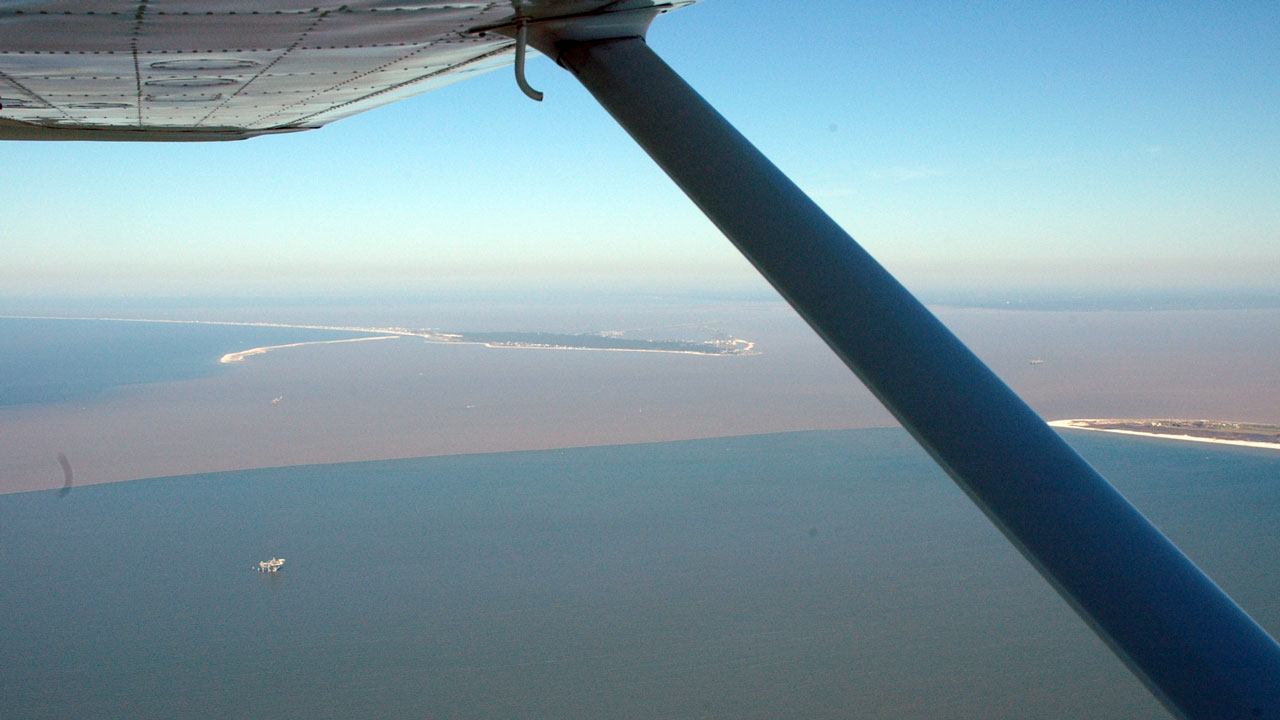
This aerial photo of the mouth of Mobile Bay shows the delineation of freshwater and saltwater mixing. The water flowing out of Mobile Bay is brackish and carries sedimient from the Mobile-Tensaw River Delta.
National Estuaries Week
Every year in September, we celebrate our estuaries. This year, the Alabama Aquarium offers a week of adventures for you to learn more about our estuaries biodiversity.
Monday, September 21
Estuarine Inhabitants Investigation
10:30 a.m.
Explore the amazing adaptations that help our estuarine animals survive in a changing environment. Get hands-on with some of our preserved specimens and investigate the creatures that call our estuaries home.
Tuesday, September 22
Guided Boardwalk Tours
10 a.m., 11 a.m., 1 p.m., and 2 p.m.
Step onto our living marsh boardwalk and explore the world of our estuarine habitat, the salt marsh. Discover how the salt marsh supports a variety of plants and animals, and learn about the important role the estuary plays along our coast. Keep your eyes open for some of the marsh’s animal residents along the way.
Wednesday, September 23
Salt Marsh Excursion
9:45 a.m.
Registration Form
Step into the role of a marine scientist for the morning as we explore the marsh and observe its inhabitants in the wild. Keep an eye out for some of its residents, including crabs, snails, and fish. Along the way, discover how salt marshes provide essential habitat, support marine life, and protect our island.
Thursday, September 24
Oyster Dissection
11:30 a.m.
Oysters are more than what you put on a cracker; they’re hardworking members of our estuarine ecosystem. During this oyster dissection, discover how oysters eat, explore their fascinating life cycle, and see how these incredible animals help our estuaries.
Friday, September 25
Research Vessel Excursion
2:45 p.m.
Registration Form
Join a professional Dauphin Island Sea Lab Educator for a two-hour boat trip in the waters surrounding Dauphin Island. You’ll learn how estuaries, such as Mobile Bay, feed the seas. A short trawl will produce a sampling of some of these animals for you to examine, and a plankton tow will give you a look at the microscopic organisms at the base of the food chain.
Transcript
Angela Levins, PR Director Thank you for joining us on this episode of the Sea Lab Sidebar. We are joined by Discovery Hall Programs educator Joanne Moody to chit-chat about estuaries. Thank you for joining us.
JoAnn Moody, DISL Discovery Hall Programs Educator Thanks for having me.
Levins JoAnn, let’s just lay out what an estuary is.
Moody An estuary is a magical, amazing place, uh, where freshwater and saltwater meet. That is kind of the definition. For us here, it’s Mobile Bay, right? That is what our local folks know. It’s the body of water where all the rivers coming down from Alabama meet the salty water from the Gulf. But the technical term for that place is an estuary.
Levins What’s kind of cool when you see an estuary is that there is a difference in color of water sometimes where you can see that delineation of the connection.
Moody Absolutely. People come down to the coast and expect to see clear water, but that’s not what we have here around Mobile Bay in our estuary because it’s being fed from that river water, picking up all that sediment across Alabama. And so it makes our water brown. But brown water is productive water. It’s full of life. You just can’t see it because it looks like chocolate milk.
Levins That’s why estuaries are often called the nurseries of the sea, because of that.
Moody Our estuaries have all these great habitats, whether it’s a seagrass bed, an oyster reef, or the salt marshes around the edges of the bay. And we have an abundance of marine life that grows up in those habitats. So whether it’s sharks or fish coming in to spawn or have their babies in the bay, or the water moving the currents and bringing those planktonic babies into our estuary, those habitats are where those babies are finding food and finding shelter, finding those safe spaces to grow up. And then either they’re going to stay in our bay or estuary and live their lives and reproduce, or there are things that are then going to move back out into the Gulf. So it is a kind of reciprocal relationship. The estuary, the Gulf, and our rivers, and they feed each other, right? The rivers are feeding the bay. The Gulf is feeding our bay. And that flow, whether it’s the river flow because we’ve had a lot of rain or a really strong tide bringing that saltwater in, it is a give-and-take, and they each feed each other.
Levins It’s kind of a cool characteristic because animals that live in the estuary have to be able to live in freshwater and saltwater because of that variation.
Moody Yes. And because of that. So that water that we would call brackish, that people are mostly familiar with, in between salinity, there are only so many things that can tolerate those changing salinities and that level. But the amount of change that we see is really the biggie, because on any given day, it could be, you know, very, very low or get very, very high, depending on whatever is going on with the weather or the tide. And so it’s those extremes, those fluctuations that kind of make our iconic Mobile Bay species or estuarine species- the blue crabs, the oysters, the shrimp, the red drum- can tolerate those changes. And so while we do have an abundance of life in the bay, the number of different species is a little bit restricted because of those changing conditions. But it makes for some really robust animals that can tolerate very, very cold water in the winter to very hot water in the summer. And then again, those changing salinities, the saltiness of the water.
Levins So the changing salinities, that’s one challenge, you know, for the animals. But what are some of the other challenges that our estuarine animals and just environments face throughout the year?
Moody Yeah. So definitely temperature. And because our bay is so shallow, Mobile Bay is rather large, you know, as an estuary. We categorize estuaries in different ways by volume of water or by area, and Mobile Bay, by volume of water, is the fourth-largest estuary in the United States. So we think of it as being this really big place, but the water is actually very shallow. That shallow water heats up so fast and so high in the summertime. And when you heat water up, the oxygen depletes really quickly. That hot water just can’t hold on to that oxygen. So some species are adapted to those low-oxygen conditions and can come to the surface and find ways to deal with it. But you know, that leads then sometimes to those events that are so unique in Mobile Bay, the jubilees that we experience typically in the summertime when that oxygen level drops because the air is still. And so we end up with things like flounder, shrimp, stingrays, and crabs coming right to the edge of the water, right to the surface. And it’s the layering of the water that really drives that. So there’s a layer of really warm, oxygen-poor water at the surface, and it layers up that way. But that temperature is a big constraint and limits species diversity in our bay, but it has supported an abundance of life over the years. Right. And they’re adapted for those conditions, which is kind of interesting.
Levins We’ve talked to Doctor Lee Smee and Doctor Christa Russell about oyster restoration. And there is that point where it heats up so much at the top that when they restore these reefs, they actually have to kind of put a barrier of recycled shell above their oysters that they’ve put out. So it’s interesting how that temperature impacts so much. it also impacts the plants that are able to be there because the plants are part of the estuarine habitat as well.
Moody Absolutely. And you know, the oysters, they’re not mobile at that stage. And so they can’t adjust their position. If conditions become unfavorable, the oxygen level drops, it gets too warm. Um, but some of those other species are able to. But plants, you know, historically, if you talk to old-timers around Mobile Bay, they will tell you that the bay was clearer and had more vegetation, more of those grasses and things growing along the bottom. But because Mobile Bay and the Gulf Coast are so incredible, over the years, lots of people have wanted to live along the coast. Unfortunately, that has increased pressure on this system in Mobile Bay and led to more sediment entering the bay. Some of it is natural. We expect that bay to be more brown than the blue-green waters of the Gulf Coast, but too much of that sediment is not going to allow those grasses to grow and establish those nursery habitats that we know and love. So one human pressure is development. So I think it’s great to see folks like Doctor Smee doing restoration work here along the coast, because I think we’re realizing more and more that if we want to continue to enjoy our estuary, we have to take care of it. And so these restoration efforts, putting oysters out our students, our high school students, this summer actually got to help do that. Put out oyster shells and live oysters, I believe, on some of Doctor Smee’s reefs. So it’s all about taking care of what we have and being able to enjoy it. The salt marsh is one of my favorite places to go and to take students because maybe they’ve been to the beach before, but the chances that you’re going to encounter wildlife at the beach are a little bit slim, other than a gull coming to steal your, you know, Doritos or something. But you take a kid to a salt marsh and let them pull a net through water that they can’t see through, but they’re trusting you that there are no alligators or things that can hurt them in that water. And they pull a net through and lift it up, and it is just erupting with life, with crabs and fish and shrimp. And that’s just not something that they have experienced before. And so I think that’s what we try to do is share this kind of not-so-well-understood habitat. People understand the beach, but maybe not so much the oyster reefs and the salt marshes, and let them experience that so they can think about it in the future. Oh, that’s something I want to protect. Oh, I want to go fishing for speckled trout, red drum, or flounder. We probably need to make sure that these habitats are here to support those things.
Levins And what’s very cool is that we do it with the students, as you said, with Discovery Hall programs in the K through twelve programs that we have here. We also offer opportunities throughout the year for all ages through the Alabama Aquarium, including National Estuaries Week, which is toward the end of September. And we’re going to have some folks here. But the estuary, like Mobile Bay estuary, is really only one along the Gulf Coast. There are other estuary spots. Where are those spots along the Gulf Coast?
Moody Absolutely. We are fortunate to have two nearby national estuarine research reserves. So there’s one in Grand Bay, just across the state line in Mississippi, and then on the eastern side of Mobile Bay at Weeks Bay. They also have a national estuarine research reserve. And the goal of those estuary reserves is to protect that habitat, but also employ scientists, biologists, uh, to, you know, research and learn as much as they can about those places and how to protect them. Um, but they also welcome visitors. So Grand Bay and Weeks Bay both have beautiful centers where you can come learn and explore. And so they’ll be hosting events just like we are here at the aquarium. So yes, I would encourage people: if you live along the coast, whether it’s the Gulf Coast or up and down the east and west coast of the US, then find an estuarine research reserve near you or just get outside. I think the emphasis behind National Estuaries Week is awareness, but also pushing people to go out, explore, and enjoy these places. So if you didn’t know, we have them close by, and I encourage you to look them up and explore. Our programs are primarily for school kids. Uh, but the programs at the Sea Lab have grown so much in recent years, both through Discovery Hall and the Alabama Aquarium, that if you can picture you and your family doing these things that we’re talking about, going and pulling a net through the water, um, to see what lives in the salt marsh. Those opportunities are out there for you. So I’d encourage you to pursue those.
Levins Well, JoAnn, thank you so much for joining us for a crash course on estuaries. And we will chat more with our educators because y’all are the backbone of our education programs here, and we’ll chat soon.
Moody Thanks so much.