 Apple Podcasts
 Spotify
 YouTube
 iHeart
Diatoms are tiny organisms that produce oxygen, form the foundation of ocean food webs, and play a surprisingly big role in our everyday lives. In this Sea Lab Sidebar, Dr. Jeffrey Krause, DISL Senior Marine Scientist and University of South Alabama Professor, helps us zoom in on the fascinating world beneath the surface of the ocean.
Which Phytoplankton are You
In the podcast, Dr. Krause shares a fun quiz you can take to determine which phytoplankton you are.
Click here to find out which phytoplankton you are.
How Big is a Diatom
Diatoms are microscopic single-celled algae that generally range in size from 2 to 500 micrometers (μm), with rare giant species reaching up to 2 millimeters (2,000 μm). The largest individual cells are roughly the width of a human hair.
3D Diatom
Dr. Jeffrey Krause created this 3D image of the diatom Coscinodiscus. The cell is stained to show newly formed cell walls, which are noted by the blue coloring. Sydney Acton, a former member of Dr. Krause’s lab, took the images of the diatom, and Dr. Krause layered them into the 3D image you see.
This diatom was sampled from the Louisiana Shelf aboard the R/V Pelican in spring 2017.
3D Plankton Models
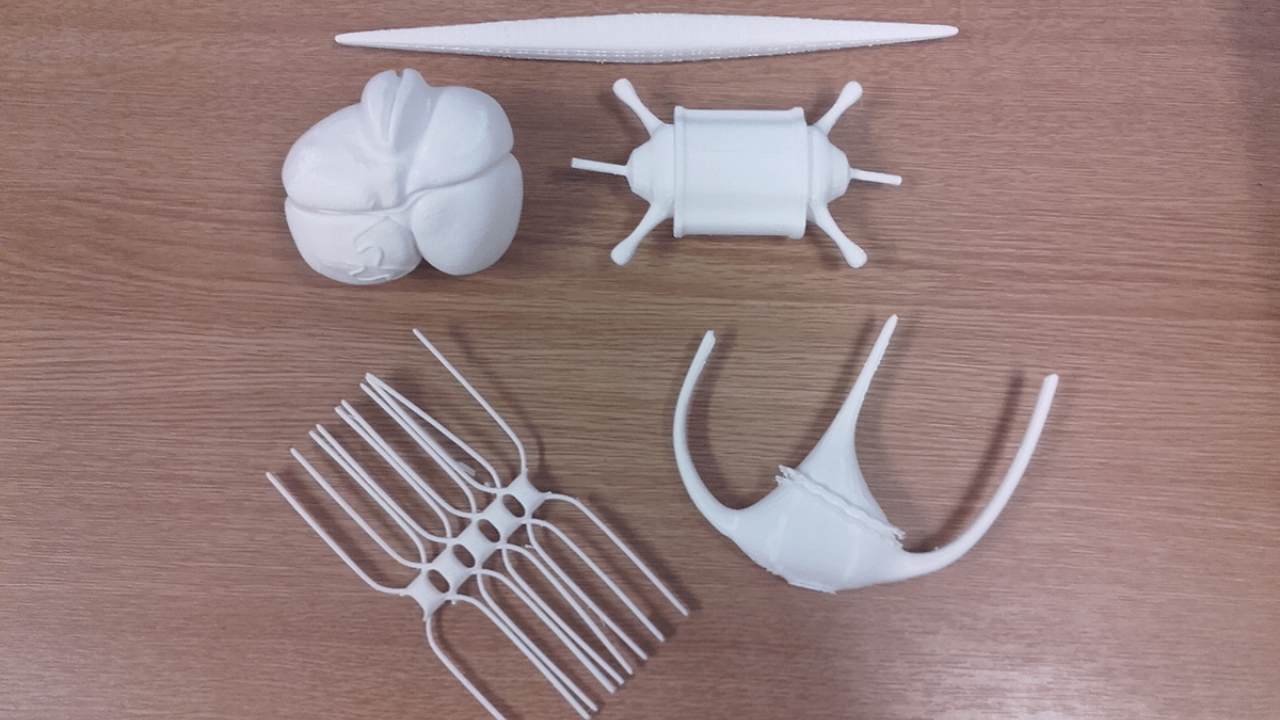
In 2017, Dr. Krause and Discovery Hall Programs Chair Dr. Tina Miller-Way on a project to help students understand these organisms by putting 3D printed models of phytoplankton into their hands.
Models include the diatoms Odontella, Chaetoceros, and Pseudo-nitzschia, and the dinoflagellates Ceratium and Karenia brevis which is the species responsible for red tides in our area.
Adaptations of these original models are also freely available at thingiverse.com.
Dr. Krause’s Favorite Diatoms
Coscinodiscus
Rhizosolenia
Odontella
Transcript
Angela Levins, PR Director Today we’re joined by Doctor Jeffrey Krause, who is a senior marine scientist here at the Dauphin Island Sea Lab, and he is a professor at the University of South Alabama. And we are going to chat about diatoms. Thank you for joining us today.
Dr. Jeffrey Krause, DISL Senior Marine Scientist It’s good to be here.
Levins Give us the down and dirty about diatoms. Let’s start right there.
Krause People think about diatoms and you might think of diatomaceous earth, which is stuff you use for industrial applications, whether it’s like a toothpaste additive or many people think it’s like pool filter material. Sometimes it can even be to help deworm livestock, but those are actually small microscopic organisms. They’re single celled microalgae. When they’re in the open ocean or in any aquatic environment, they’re known as phytoplankton, and they are a group of phytoplankton that are really important to how the world operates. Specifically, they give us as much oxygen as all the rainforests combined if you sum up them globally. So they’re one type of phytoplankton, one type of microalgae, but they have a pretty important impact.
Levins How big is the biggest diatom and how small is the smallest diatom?
Krause Excellent question. They have a pretty fantastic range. like you think about the range for a species humans, right? We go from maybe a couple feet tall to, you know, maybe seven feet tall. That’s kind of our general range. Diatoms can range with the smallest being two micrometers. So that’s two thousandths of a millimeter up to about two millimeters. So there’s about a thousand fold range in their size. Most diatoms in the environment are not that small, nor are they that big. And they’re typically in the range of anywhere from ten to fifty microns. So there’s one thousand microns in a millimeter.
Levins And I asked that question because you can’t necessarily see a diatom.
Krause That is true. The biggest ones would almost look like maybe a little speck or crumb that’s floating in your water. And again, those are the biggest by far. Most of the diatoms that are in the environment, you will not see without the aid of a microscope.
Levins And then, to be clear, if the diatoms are floating with you, even if you can’t see them, they don’t necessarily hurt you in the water.
Krause Absolutely. Diatoms, like many other plankton, that is their natural habitat, typically microalgae and phytoplankton in particular, where there is light and water, you’re going to have them, whether it’s in a lake, whether it’s in an estuary, whether it’s in the ocean. Diatoms can even find their way into the underside of sea ice, where they can be especially abundant. And they’re very important ecologically there. And some diatoms, when they live on the surface of the sediments, they’re not called phytoplankton anymore because they’re not plankton. They’re called benthic microalgae because they live in the sediments. And typically they can’t be in the deep sea where there’s no light. So you need sediments and you need areas where light can get to the bottom. But they can they can be in a lot of different habitats
Levins How are they creating that oxygen?
Krause Great question. So diatoms like land plants do photosynthesis right. so photosynthesis is something that we can’t do as humans. But basically what it is, it’s kind of making your own food, using sunlight as power and using carbon dioxide as, kind of a carbon source. Diatoms do this in the surface layer of the water where the sun is, there’s usually plenty of carbon dioxide for them to use. And then you need other nutrients. You can think of them as like fertilizers for crops. So they need a source of nitrogen and they need a source of phosphorus. They have their carbon. They put all those nutrients together using the energy given to them through photosynthesis, basically fueled by the sun. And then they build their biomass. So we do it a little bit differently. We consume organic molecules, we digest them, and then our bodies put them together in what we need them to do. Diatoms, like land plants, do the opposite.
Levins So we appreciate when the diatoms go through the photosynthesis process because by taking that carbon dioxide, it’s an important part of keeping us with clean oxygen. Correct?
Krause Yes. So one of the ways that they help regulate the carbon dioxide in the atmosphere is they are consuming it like other plants, right? A byproduct of photosynthesis is oxygen. And that’s of course critical for us to breathe. So if you sum up all the photosynthesis done on land versus the sea. Mind you, the sea is made mainly by not only diatoms, but other groups that you cannot see. Other types of phytoplankton, they give us about equal quantities of oxygen produced. The land has a slight edge, but land plants have about five hundred times the biomass that phytoplankton do in the ocean. And diatoms as an individual group, give us about the same as all the rainforests combined globally. If you just put them all up on a scale and put them next to each other, it would be pretty tremendous.
Levins That’s pretty fascinating that something that you can’t see is so important to us within the ocean, but that also goes to the side of the health of the ocean and the diatoms. Are there things that can constrict the health of a diatom?
Krause Absolutely. diatoms are unique among phytoplankton and microalgae. They have a requirement for silicon. Not every phytoplankton uses this. But diatoms are special because they make a shell made of silicon. You could also think of it as like glass because glass is made of silica. So they make this glass shell. And that means that they need silicon as well. And so when you alter the delivery of silicon relative to other nutrients, let’s say nitrogen or phosphorus, which are used in fertilizers, you can change how diatoms operate in the system downstream. An example of where this has been seen is in the Mississippi River. The Mississippi River drains a lot of farmland, and during the mid to end of the twentieth century, a lot of fertilizers were being used as industrial agriculture was developing. That changed the proportion of nitrogen and phosphorus going into the northern Gulf relative to silicon. Some investigators have suggested that it has shifted the food webs away from diatoms. And that has had some consequences.
Levins I’m happy you brought up food webs, because when we think about diatoms, they are the start of food webs.
Krause Absolutely. Diatoms, like phytoplankton in general, are the base of the food web. So if you think about land, a cow in a field, you know, the grass in that instance is the base and then the cow eats the grass. Ultimately, if you’re a meat eater, you eat the cow. Other things can be the start in a terrestrial system. So when you get to the ocean, diatoms and other phytoplankton, they are the producers like that grass on land, and they’re the ones that bring organic matter or carbon into the food web, which is available for other things to eat. So diatoms and other plankton get consumed by small plankton, which are animals. We call them zooplankton. Zooplankton get consumed by maybe other zooplankton or small fish. Small fish get consumed by big fish, big fish by bigger fish, and you work your way up to the food web. Maybe do a whale or of course, a human. And so it works its way through the food web. But it all starts at the bottom where you create that material, that food, that organic matter. And that’s typically diatoms or phytoplankton.
Levins So when we talk about diatoms and we talk about the food web, and we talk about the oxygen that they help to create and pulling the carbon dioxide out of the air, there’s really not a piece of marine research that doesn’t involve some connection to a diatom.
Krause Henry Bigelow, who has a laboratory named after him, coined a phrase in the early twentieth century that all fish are diatoms. Again, it’s the recognition that ultimately the organic matter in a fish, the food, the flesh of a fish started somewhere lower in the food web, and it was created by effectively a plant like organism. Phytoplankton and diatoms are really important phytoplankton in areas of the ocean where we take a lot of fish. You can think of the menhaden in the northern Gulf, you could think of the pollock in Alaska, you can think of salmon and different things that are coming on the west coast of the US, or even the anchovy in Peru. Diatoms are typically the dominant phytoplankton in these groups or in these regions. To that extent, they kind of touch a lot of these different facets, even though they might not be directly linked, like a big diatom isn’t eaten by an orca.
Levins but an orca is going to eat something that started by eating diatoms.
Krause Absolutely. An orca will eat something that started probably by consuming a diatom, just many, many links along the food chain later.
Levins So we’ve kind of bounced around with a lot of things, but what are some other pieces of the diatom that I haven’t asked you about yet? Where do they go when they die?
Krause Well, like everything in the ocean, when it dies, the ocean is really food limited, right? So usually if there’s stuff hanging around, other things will eat it. But there’s, there’s a small bit of material that escapes and it just sinks to the bottom. And then it winds up going into the sediments. And there in the sediments, it can also get eaten or consumed, maybe by worms, maybe by, you know, if it’s the shallow areas, maybe by small fish. And if it escapes that and it gets buried in the sediments, then it starts an even longer process through geological time where it gets turned into things like oil, right? So diatoms, phytoplankton, at least in marine systems, ancient remains can be turned into fossil fuels over long, long, long timescales. So I always like to think of phytoplankton and diatoms. You know, they affect us in three big ways. They give us fumes, the fumes in the air that we breathe, especially oxygen. They give us food, you know, the base of the food web and marine systems, and they give us fuel for our vehicles, which is an important thing for anyone driving a car. that’s a long, long scale fate of what happens to them when they die.
Levins What kills a diatom? I mean, of course eating, you know, when they’re consumed by other animals. But, you know, if they’re not consumed by something and they’re floating, what is going to kill a diatom?
Krause What is going to kill a diatom? Great question, because in the marine world, there’s not many things that die of old age. Maybe some of the biggest organisms will die of old age, but diatoms are almost always eaten. Um, or they can actually succumb to viruses. There are different types of viruses out there, whether they’re a DNA virus or an RNA virus. In fact, diatom viruses are some of the smallest viruses known to nature. They’re they’re even they’re a lot smaller than like the Covid virus, for instance. Diatoms can actually kill themselves. Kind of sounds odd, but there is a mode called Programmed Cell Death in which it’s a molecular thing at the cellular level. There’s a gene that gets turned on and it basically says shut down, kill yourself in population levels. This can be helpful because you can potentially preserve a population. But diatoms also have another phase where they can just go into a kind of hibernation. They can create spores or think of it as like a resting stage where they just sink into the sediments and they’re not dead, but they’re not really alive. It’s a weird existence. But think of it as a seed. And when you can put that seed back into the water and the conditions are right, they can germinate and then they can propagate again. And there’s other groups of phytoplankton that do that as well.
Levins There are a lot of phases of a diatom between food, oxygen, sediment health, and then even the fact that they can turn themselves off and turn themselves back on. So could we call them like an Avenger of the marine system?
Krause Tiny Avenger. Maybe that would be fun. I think of them as these little engines, if you will, of the ocean. And there’s a lot of organisms like that in the ocean, especially ones you can’t see whether they’re different groups of bacteria, different groups of single cells, which we call protozoa. Diatoms can be considered a protozoa as well. You could think about other consumer single cells. They do all these important functions. And we just really don’t have a good sense of it because they’re too small for us to observe without help, like a microscope.
Levins So as we’re about to wrap up, the one thing I want to know is what is your favorite diatom?
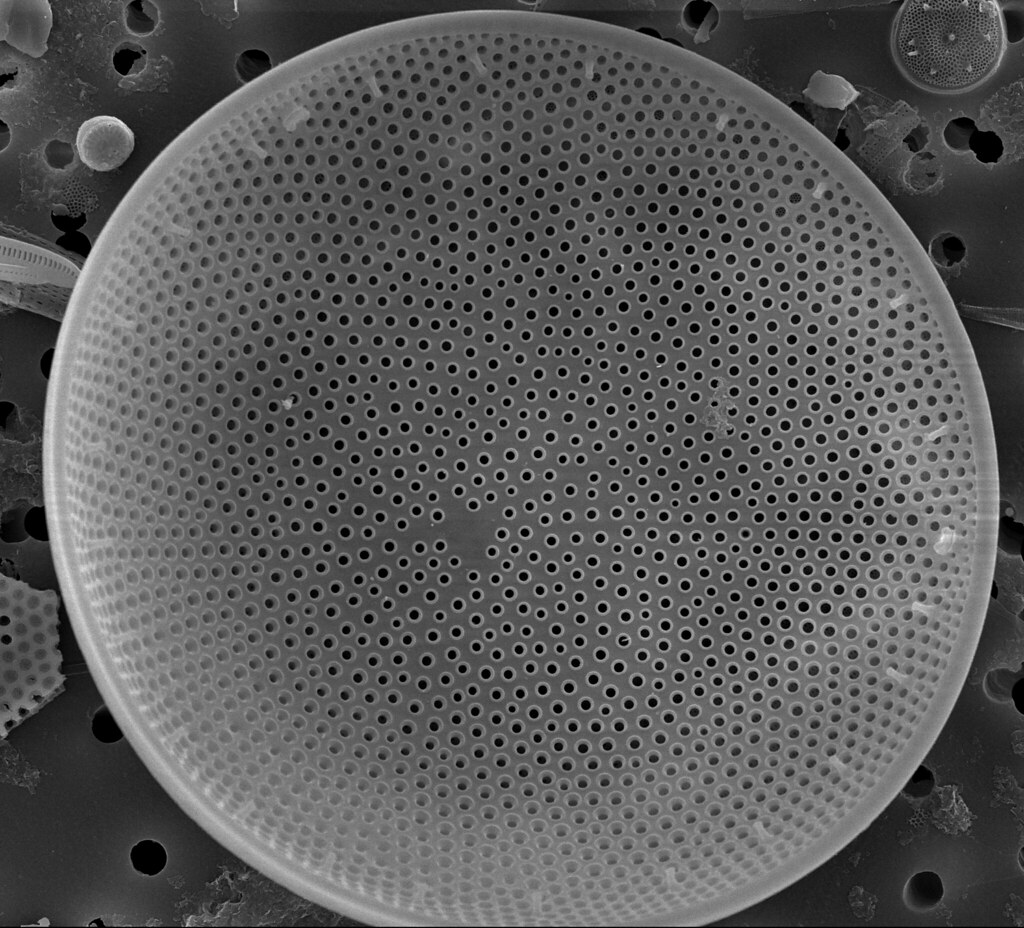
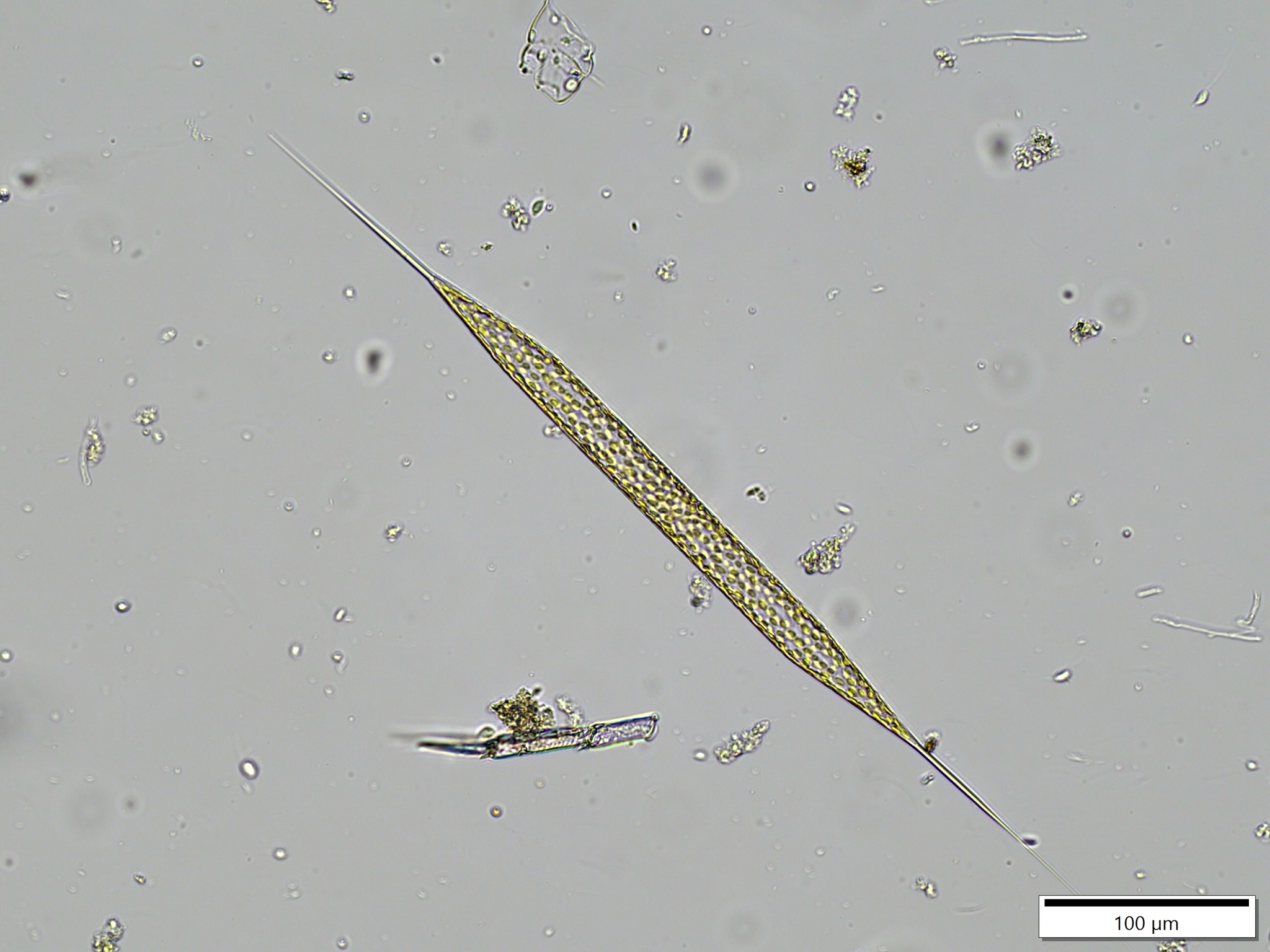
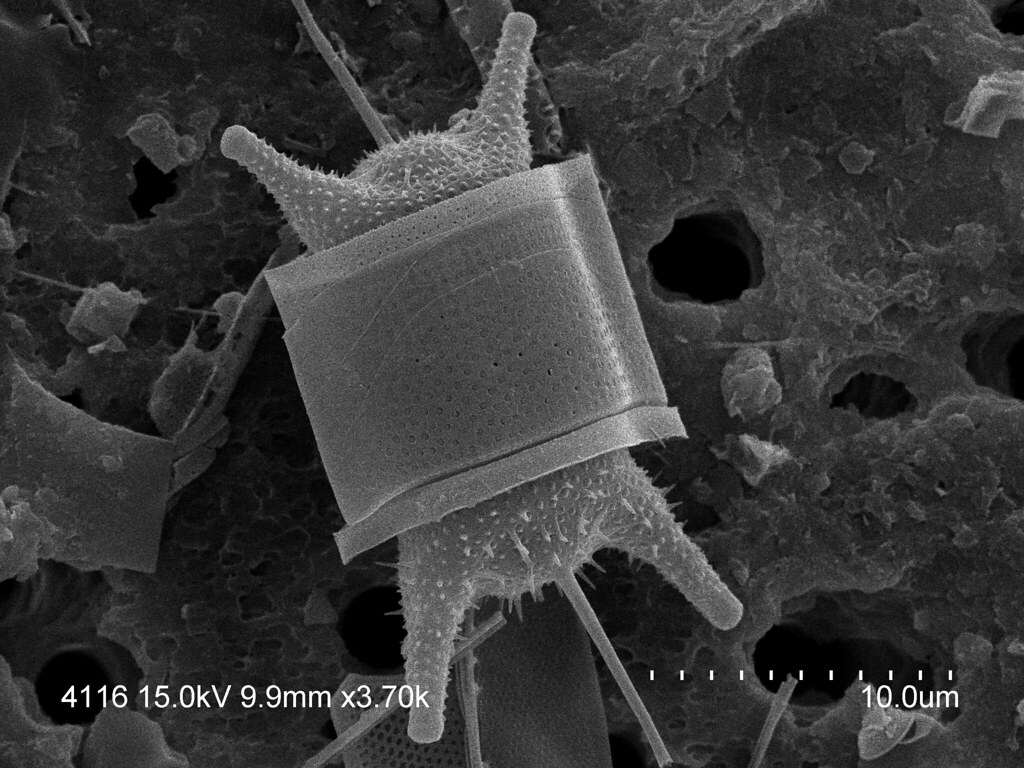
Krause Oh goodness, that’s a great question. There are a couple. There’s one called Odontella. It has a beautiful kind of set of horns. It’s kind of beautiful. Many diatoms are just gorgeously symmetrical. They have these wonderful patterns. There’s one called Rhizosolenia. It looks kind of like a pointy stick, but it’s really pretty because if you zoom in, its shell is almost like a spiraling work. So imagine a staff or a mace that has a kind of a spiral metal joint that runs down it. It kind of looks like that when you zoom in. Really cool to look at. And then there’s one that kind of looks like a big pill box. It’s called Coscinodiscus. It is about a giant, it’s two hundred microns. So two tenths of a millimeter giant by some standards. But when you zoom in, it has these beautiful pores that are almost hexagonal. They’re very intricate and they’re just ordered structurally, symmetrical. They’re really pretty. And people actually have used diatoms to make art. It goes back to the Victorian days when they would pull individual diatoms and arrange them on slides. And then you zoom in on a microscope and you have this mosaic of diatoms. So there’s a gentleman who passed away a couple years ago. His name is Klaus Kemp. There’s this beautiful video on there called the Diatomite. And it kind of goes into his obsession about making art with diatoms. He used other things because he was an artist by trade, but he used other things. But you can make art with diatoms too, which is something that we enjoy in my lab.
Levins Right before we started, you actually helped me figure out what phytoplankton I am. And so this is another fun thing. It’s not just art, but we can relate to them.
Krause Yeah. So NASA launched a satellite a couple of years ago. The satellites acronym is pace, and this is a satellite that has a camera system that is really sensitive to different types of light wavelengths. And the interesting thing about different phytoplankton groups is they have different pigments. And those pigments absorb light a little bit differently. So from space, we can look at different phytoplankton groups, not just the total of what’s there, but with this satellite, we can do that. And NASA a couple of years back, they put the phytoplankton personality test. It’s very scientific. You answer four questions which talk about your, you know, your dancing habits. Do you like to swim? What colors do you wear and where do you want to go on vacation? So it’s not really cerebral, but it’s hilarious. It’s fun. And there’s a lot of different options. And Levins, which one are you?
Levins Trichodesmium.
Krause Trichodesmium. You are Trichodesmium. Which is a fun one because, as I was mentioning, these things are colonial, which means, yes, they’re a single cell, but sometimes they can live together. And then, these were even noted by Darwin on the Beagle in the nineteenth century, because when they come together in a colony, they’re big enough to see. They still look like a small speck in the water, but you can see a small speck in the water. You can’t see something smaller than a speck.
Levins It’s absolutely fascinating. And we could honestly talk about diatoms for hours and hours, which means that we’ll just have you back on to talk more about your research into diatoms.
Krause Sounds fascinating and sounds fun. And clearly I can talk your ear off.
Levins Well, we appreciate it, Dr. Krause. And we’ll talk to you soon.
Krause Thank you very much.