 Apple Podcasts
 Spotify
 YouTube
 iHeart
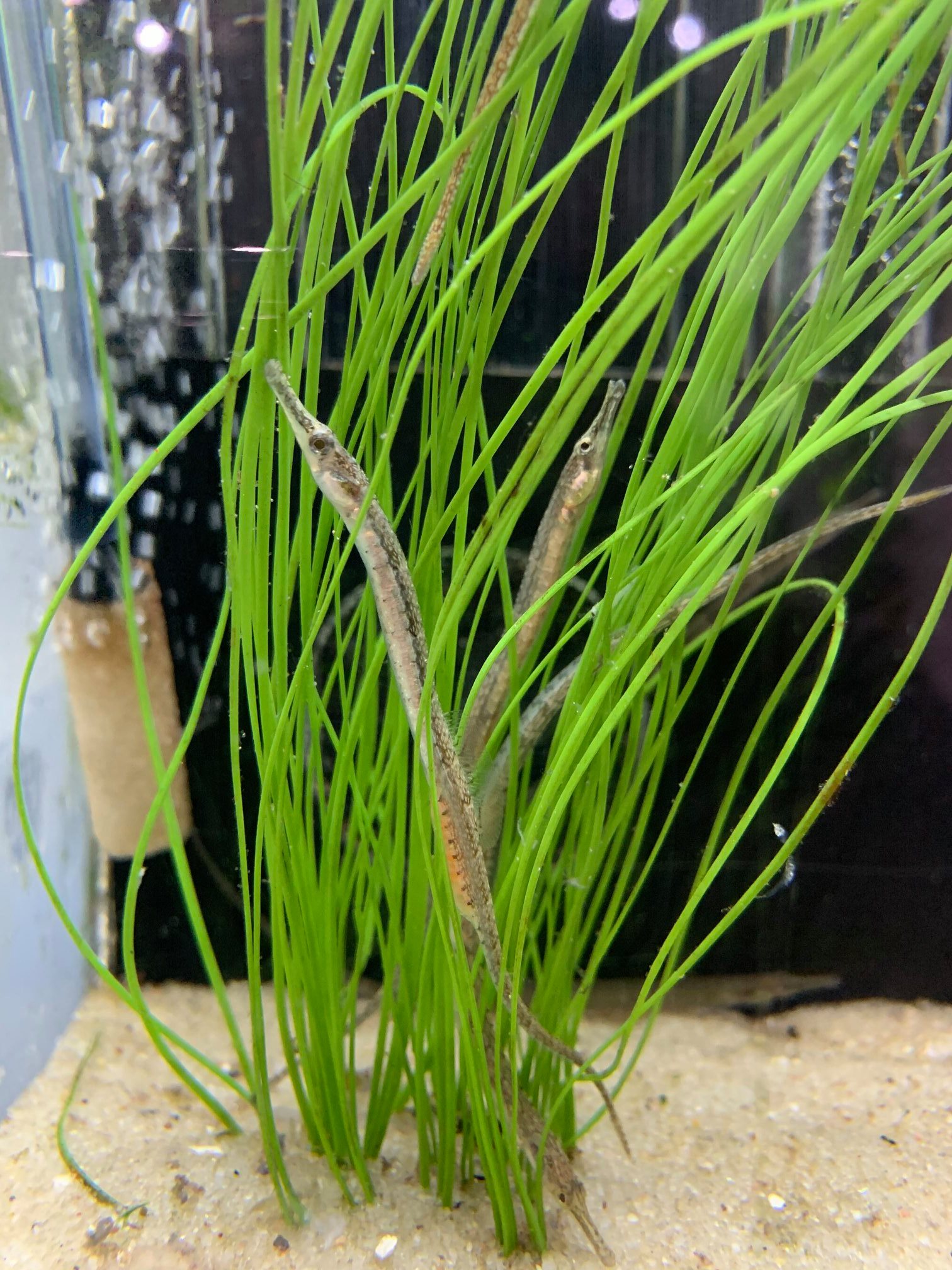
Pipefish
Seahorse Courtship
Seahorse courtship is extensive, beginning with a male approaching a female, brightening in color, and quivering. The female will then return the display. The two will circle around their holdfast. After a couple days of this behavior, the seahorses start pointing their snouts to the surface, and the male will likely pump his pouch. Finally the two will rise together through the water column and the female will transfer her eggs to the male’s pouch.
Baby Seahorses
The Alabama Aquarium has raised more than 200 seahorses over the last few years, mainly through the hard work of Senior Aquarist Devin Linsday. These efforts allow the Aquarium to share these amazing creatures with other aquariums and groups. These include:
- Gulfarium, Fort Walton Beach, Florida
- New College, Sarasota, Florida
- Memphis Zoo, Memphis, Tennessee
- Virginia Living Museum, Newport News, Virginia
- Tennessee Aquarium, Chattanooga, Tennessee
- Long Island Aquarium, New York, New York
- Shreveport Aquarium, Shreveport, Louisiana
- Gulf State Park, Gulf Shores, Alabama
- Central Campus, Des Moines, Iowa
Related Articles
Transcript
Welcome to the Sea Lab Sidebar. Your quick dive into the science, people and discoveries shaping our goal. Join us as we explore the research and stories happening every day at the Dauphin Island Sea Lab.
Angela Levins, PR Director Mendel, thank you so much for joining us. And so today we’re going to chat about seahorses and pipefish.
Mendel Graeber, Alabama Aquarium Director Thanks for having me.
Levins Seahorses are kind of cool and majestic. And it’s really neat to see them in the Aquarium. What do we not know about a seahorse?
Graeber I think that a lot of people don’t realize that seahorses are fish. And often we hear pretty often that people didn’t realize they were real animals. A lot of people think that they’re fantasy animals until they see them live at the aquarium. They are fish. If you see them swimming in the tank, you can notice a dorsal fin. That’s the fin on the back. And they have fins that are sort of in the place where you would expect to see ears. And then they use a prehensile tail to wrap around seagrasses. Some related species might be found in floating seaweeds, so they use that tail to anchor themselves to something, and then they are ambush predators. They don’t swim very far, so they kind of lie in wait for the little amphipods, the little tiny crustaceans that they like to eat. And so they have a very fast kind of strike where they snap forward and slurp up their live little amphipod prey that’s related to shrimp. They eat other things as well, but so their snout is kind of like a straw. And they will snap at their prey and slurp it up.
Levins Kind of like an anteater sticking their nose in to get the ants out.
Graeber They have that nice long snout with it.
Levins So do they have okay, do they have teeth? Do they have a tongue?
Graeber There’s sort of a little like flap that is at the end of that straw like snout, and it opens and closes very quickly. Sometimes you can even hear it. We feed them live brine shrimp. And so you can listen for that little snap of their snick is what it’s called.
Levins The other thing that people tend to talk about with seahorses is their mating side of things, but also the fact that the dad becomes a big part of the process as well.
Graeber Yeah. So you might hear that the dads are the ones who get pregnant. So I like to clarify that the females produce the eggs. By definition, if an animal produces eggs, it’s a female. The females deposit their eggs in the male’s pouch. The male has a pouch that is sort of located where you might think you would see like a belly. And in that way it sort of looks like a kangaroo pouch. And people think of it sort of like a pregnancy, like you might see in mammals. So they are carrying those eggs. And then when the eggs hatch, they come out of the pouch. The father will do sort of a, he’ll have contractions and you’ll see the babies kind of squirt out of the pouch. Sometimes you’ll hear that seahorses are the only or the only group of animals where the males get pregnant and have the babies. So it’s not a pregnancy like a mammalian pregnancy exactly. They don’t have a uterus. And of course there, you know, that would be a female characteristic. They’re not producing eggs. And there are other male animals that will carry the babies. There are toad species. There are other species where the males will carry the eggs and sometimes the babies after they hatch. But this one sort of more closely resembles a human or mammalian pregnancy with the location of the babies, the pouch.
Levins We have had some really cool experiences here at the Aquarium where sometimes we have seahorse babies and they are so small. But when they’re small, you can even see them using that little tail to grab on.
Graeber We do have breeding seahorses at the aquarium and periodically we have babies. So every once in a while we get to watch the males have the babies. The baby seahorses look like teeny, teeny tiny adults. So I’d say if you were thinking about something you could compare it to maybe. End of a pencil. The babies begin that small, and we do have a lot of success raising those babies, and we share with other programs. We have the babies in our tank for a few months, raising them and allowing our visitors to see them, but we would kind of have an overpopulation of seahorses if we kept all of the babies that we raise
Levins Seahorse babies, they’re not easy. It’s not like you just, you know, toss them a couple fish flakes.
Graeber The babies are not easy, and neither are the adults. So we discourage people from having seahorses in a home aquarium, although they are really cool fish. We have a staff of five on our aquarist crew who work full time, keeping all of our animals alive, and seahorses are notoriously difficult. They like to eat live food, so we raise food for them in house. It’s hard to train them to eat frozen or they don’t eat flake food like you might feed other fish. We encourage you to come see them at the Alabama Aquarium.
Levins In the tank where we have the seahorses is their cool cousin, which is the pipefish. Give us just a little bit about the pipefish.
Graeber Pipefish kind of look like if you stretched a seahorse out straight and sort of like rubbed its belly smooth. So they are long and straight, but they resemble their seahorse cousins with their dorsal fin and the little fins on the sides of their face and their straw like snout. And we find them periodically catch them in our local salt marshes. And they are also similar to their seahorse cousins and that the males carry the babies.
Levins Interesting. So lots of stuff that can be learned just in one tank at the Alabama Aquarium. Thank you Mendel, and we look forward to having our guests here to learn more about him.
Graeber Thank you.