 Apple Podcasts
 Spotify
 YouTube
 iHeart
The Sea Lab Sidebar is your quick dive into the science, people and discovery shaping our gulf. Join us as we explore the research and stories happening every day at the Dauphin Island Sea Lab.
In this episode, Alabama Center of Excellence Deputy Director and seagrass expert Dottie Byron shares why seagrass is a foundational habitat, how they recruit birds to help restore seagrass beds, and what you can do to protect this vital habitat.
Bird Stakes
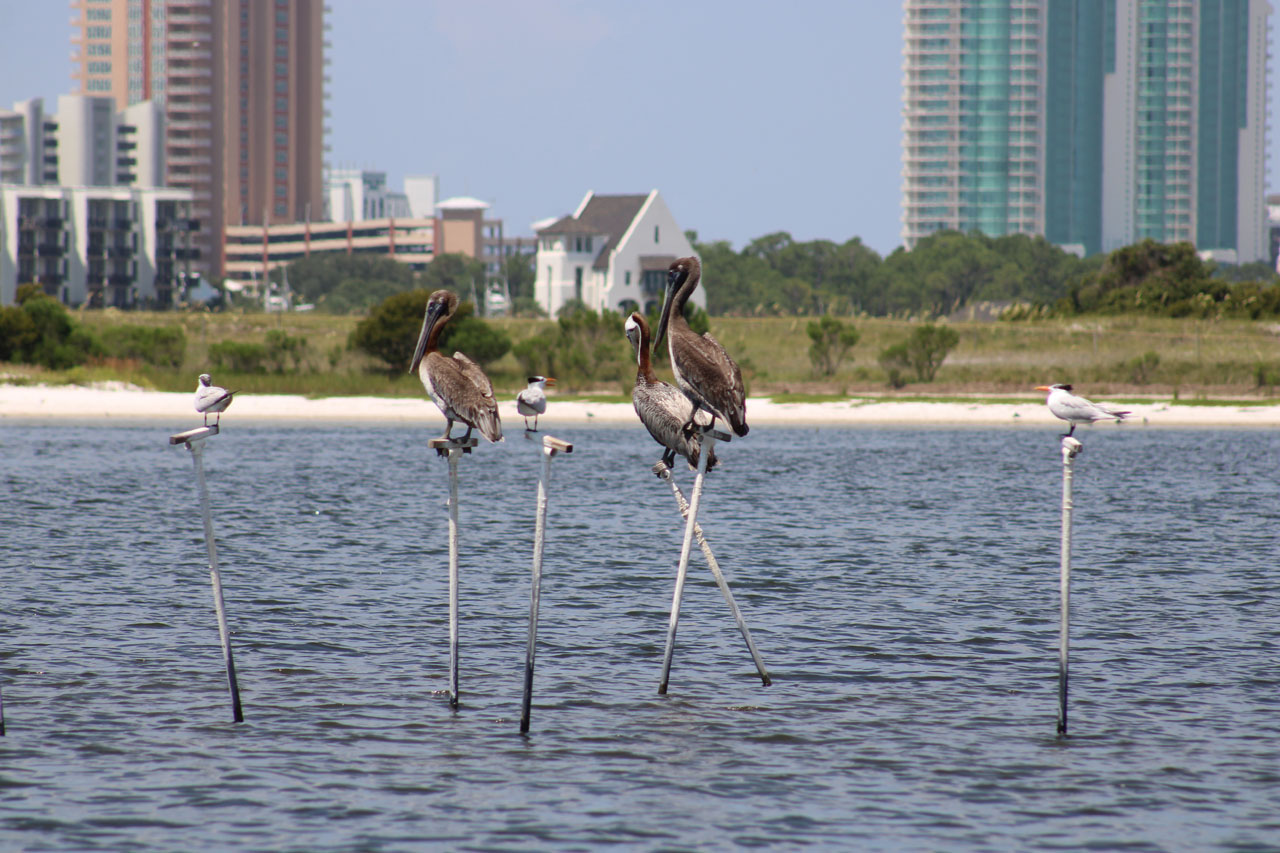
Dottie explains how they recruit birds to help restore seagrass beds. They do this by placing stakes around an area of restored seagrass. The birds enjoy these perches, and provide natural nutrients for the seagrass beds.
The photo above shows pelicans and terns resting on the bird stakes at the site of seagrass beds in Lower Perdido, Baldwin County.
Propellar Scar
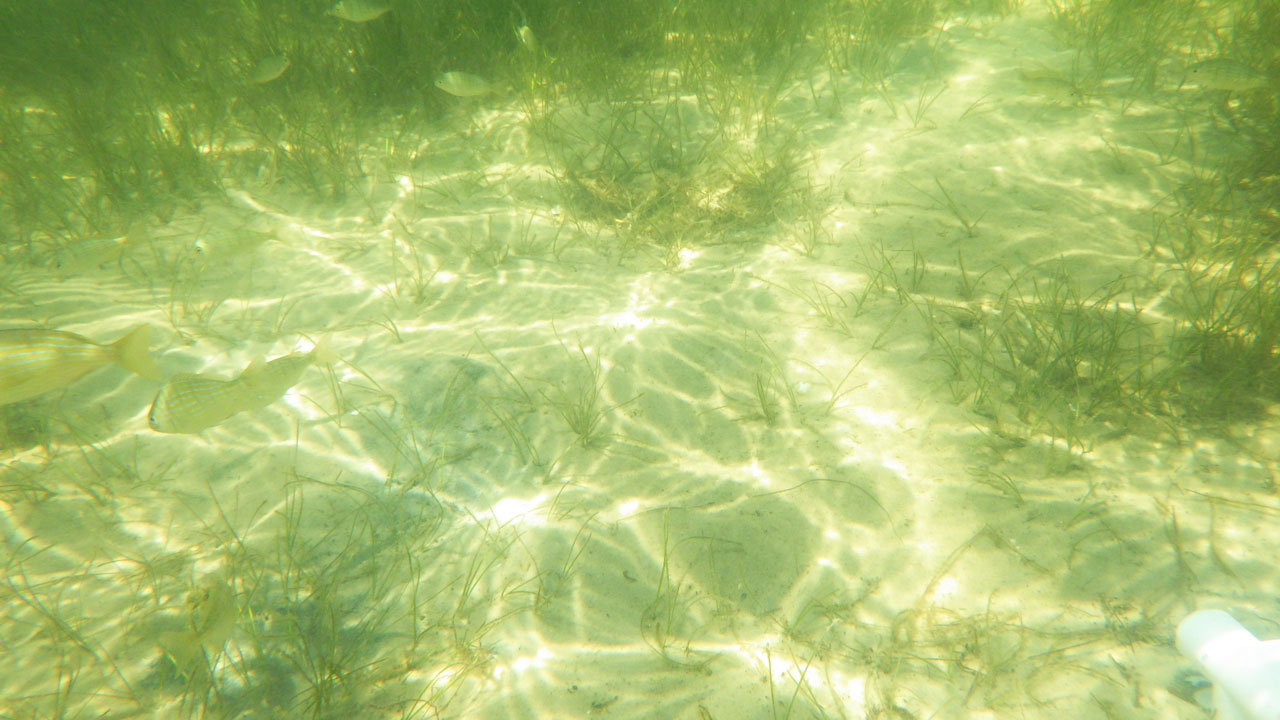
Seagrass is found in shallow water, and when boats travel through these shallow waters they can unknowingly create propellar scars. Dottie explains these scars can expand, depleting the seagrass bed.
One way you can help prevent propellar scars is by trimming your motor up when you’re in shallow waters.
Seagrass Related Articles
-
Alabama lawmaker seeks to combat seagrass loss with restoration task force
AL.com
February 3, 2025 -
Lower Perdido Islands receive seagrass transplant to combat erosion and encourage land growth
Gulf Coast Media
August 5, 2024 -
The Roots of Life: Seagrass and the Carbon Connection
CURRENTS, Mobile BayKeeper
2024 -
Dauphin Island Sea Lab restoring aquatic grass along Alabama coast
Alabama News Center
June 25, 2020
Transcript
Welcome to the Sea Lab Sidebar. Your quick dive into the science, people, and discovery shaping our Gulf. Join us as we explore the research and stories happening every day at the Dauphin Island Sea Lab.
Angela Levins PR Director: Joining us today is Dottie Byron. She is the Deputy Director of the Alabama Center for Excellence. Thank you for joining us this morning.
Dottie Byron – ALCoE Deputy Director: Good morning. Thank you for having me.
Levins: We’re going to chat about seagrass today. And it’s something that you’ve spent years studying.
Byron: Yeah, I’ve been studying seagrass since the late nineties. I did a master’s in Miami at Florida International University. And I focused on the physiological responses of seagrass to changes in salinity.
Levins: When we talk about seagrass, I think one of the first things that we need to do is we need to define what seagrass is for our audience.
Byron: Seagrasses are a subset of what are known as submerged aquatic vegetation. Submerged aquatic vegetation is actually a larger group of plants that encompasses our freshwater macrophytes. So, plants that you’ll find in the Mobile-Tensaw Delta, as well as those plants underwater that you find on our coastal areas, which are in the more marine or saline habitats.
Seagrasses are specifically those marine plants, so they can tolerate a lot of salt, but they’re all underwater.
Levins: A good point to say is that all seagrasses are submerged aquatic vegetation, but not all submerged aquatic vegetation is seagrass.
Byron: That is a correct statement. Yes.
Levins: When we talk about seagrass, which is our marine environment and, in the salt, what are some things that people should know about seagrass as far as just the broad overview of the benefits that that seagrass provides to a habitat.
Byron: Seagrasses are known as a foundational habitat. And what that means is by just their presence, they create a whole ecosystem. Their leaves in the water column slow the water down as it moves across a seagrass bed. Their roots and rhizomes aerate the sediment that they’re growing in. That and all these things change that habitat and make it more appealing to animals to come in and live there.
You have different larvae that are in the water column. And as they go across the seagrass bed and the water slows down, they tend to settle. So that’s why seagrass beds are a great nursery habitat. Their roots and rhizomes in the sediment are aerating the sediment, so, you’ll find a lot more animals living in the ground in the sediment at that time. The layer that has oxygen in it is deeper. And because of those sorts of physical properties, they also provide other ecosystem services like buffer waves.
As the water moves over, it slows down. It buffers the waves. They also accumulate sediment. So, it makes the areas that they grow shallower. And that’s important too, because they want to be closer to the light. Like all plants, they need sunlight to live and photosynthesize and fix carbon to grow. And so that’s one of the things that’s really important for maintaining a healthy seagrass bed is good water quality.
Levins: Does the seagrass help with the water quality?
Byron: Yes, actually it does. Again, those physics of slowing the water down sediment in the water column when it hits a seagrass bed. It also allows it to settle down into the bed. Also, because they are plants and they need nutrients, they can absorb some nutrients in the water column, but they can’t fix an overabundance of nutrients.
Tampa Bay is a great example of this where there was a large phosphorus problem, and it was just too much for the plants to take. It ended up reducing the water clarity because the plants could not uptake that much. And so, then you ended up with a decline.
There’s a balance in the water quality where they help maintain good water quality, but they can’t fix bad water quality. That has to be done upland and upstream.
Levins: When you talk about upland and upstream, what we’re talking about is the runoff from fertilizers. And this is not just like an agriculture runoff. It’s things that we put in our regular grass to help it grow can also be part of that runoff that can increase nutrients within a water system. Correct?
Byron: Yes. Within a watershed, just timing of when you fertilize your lawn can be important. If you fertilize right before a big rain, and then all of those sort of just leach out and end up in our streams and rivers, and then ultimately into the bay and on the coast.
Levins: As a recreational boater or someone that enjoys being around water, what are some suggestions that you have to help make sure that we protect those seagrass beds when we see them?
Byron: Seagrass like to grow in shallow water again because they need light and, unfortunately, when we’re in a boat, sometimes we find ourselves in shallow water. If you find yourself in a seagrass bed, go ahead and trim your motor up.
If it’s too shallow and you don’t have a pole. Turn your motor off and walk out to deeper water. If you do have a pole, you can just push yourself out. And those things that you do keep you from damaging the seagrass beds.
Levins: Dottie, when we talk about making those intentional efforts to not damage the seagrass bed when you’re there, why do we want to do that?
Byron: When you’re in shallow water and your propeller is hanging lower, what happens is that you end up creating a propeller scar through the bed. And while it seems like it’s just a small area, shallow water areas tend to accumulate a lot of these scars as people hit the same area over and over again. What it ends up doing is taking a once large area and dividing it up. One of the things we say it’s death by a thousand cuts.
One of the things that we have done since my time here at the Sea Lab is we’ve gone out and tried to restore those propeller scars, to take a very fragmented habitat and make it back to where it was one continuous habitat. One of the first projects we had when we got here, when I got here, was the grass beds at the lower islands of Perdido, between Robinson Island, Bird Island and Walker Island. That area used to be completely open. Currently, it’s a no motor zone.
One the first projects we had was to work with Marine Resources Division (MRD) to make that area a no motor zone, because it was so shallow and people were just cutting it up and up and up with their boat propellers because they didn’t know. It’s no fault of anyone’s. Sometimes you just don’t realize how shallow you are.
What we do is go out to these scars and we use a really low impact, cost effective technique called bird stakes. And we use nature’s fertilizer, which is basically you put a pole in the ground with a perch on top and the birds like to perch, and so you get pelicans and terns. I’ve seen osprey and they sit on these perches and while they’re resting, they do their business as birds do. And just that little bit of nutrients in their guano will help stimulate the growth, fertilize the plants and stimulate the growth so the grass can grow back into that scar and heal the area. So, instead of having a bunch of little cuts, you end up having one continuous habitat again.
Levins: That’s really cool that you use what’s just what nature provides to help regrow these beds and fertilize them. Dottie, thank you so much for joining us and for talking about seagrass and ways that we can protect it and why it’s important for us. We hope that somebody takes a little bit of what we share today, um, back home with them.
Byron: Thank you for having me.