 Apple Podcasts
 Spotify
 YouTube
 iHeart
Oysters are called ecosystem engineers because they build their habitat, but sometimes they need a helping hand. We chat with researcher Christa Russell from the Smee Lab about oyster restoration.
One way you can help oyster restoration is by donating your oyster shells. The Alabama Coastal Foundation has an oyster shell recycling program. You can find more information about it at this link.
Before the Oysters Settle
Oyster Restoration Projects
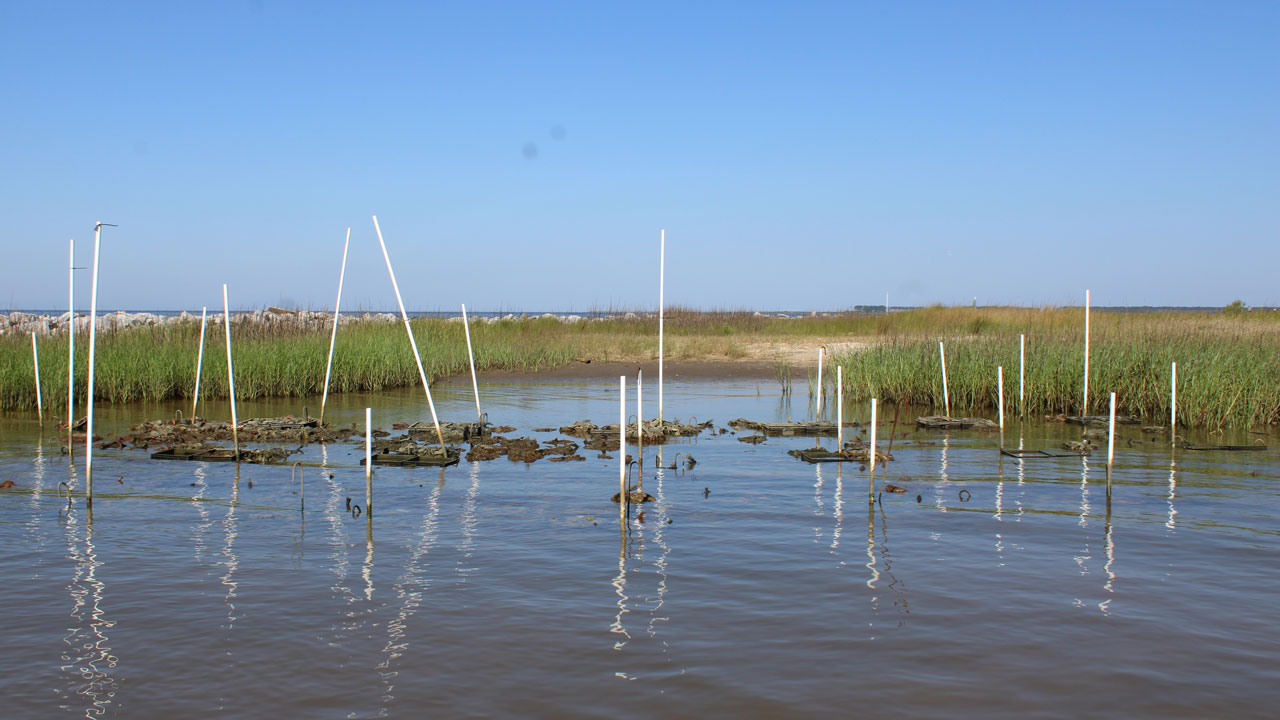
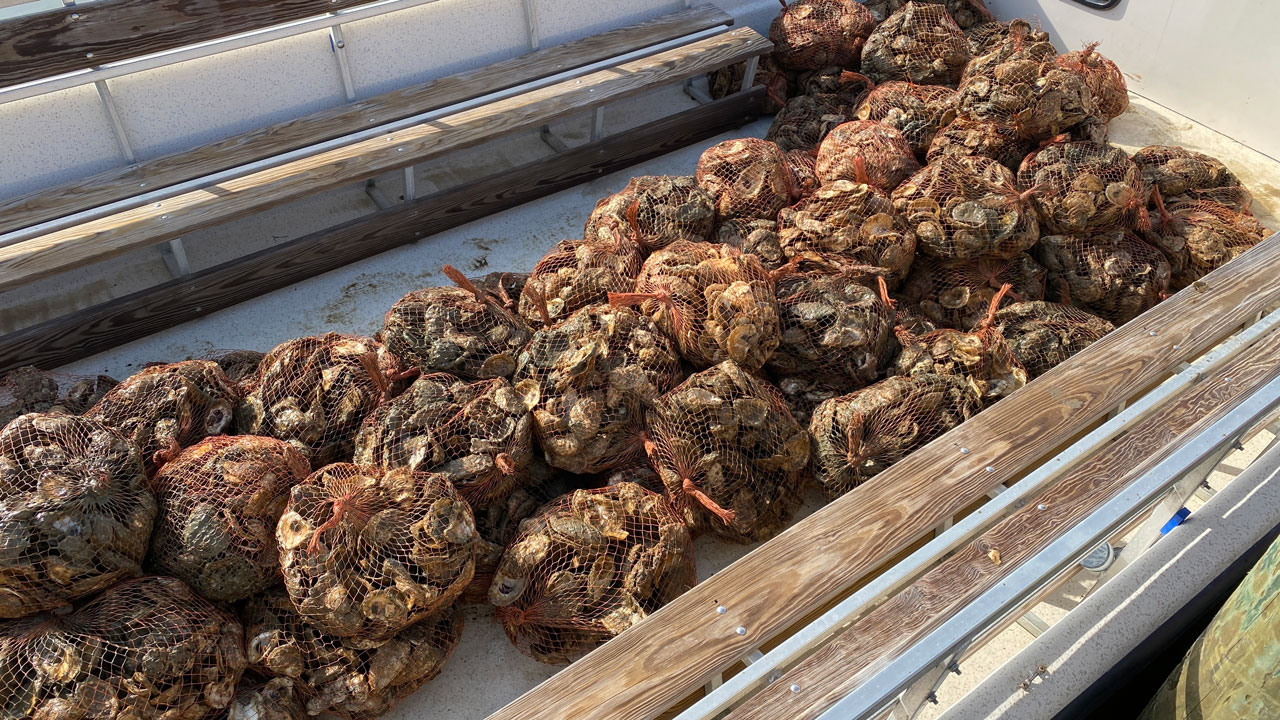
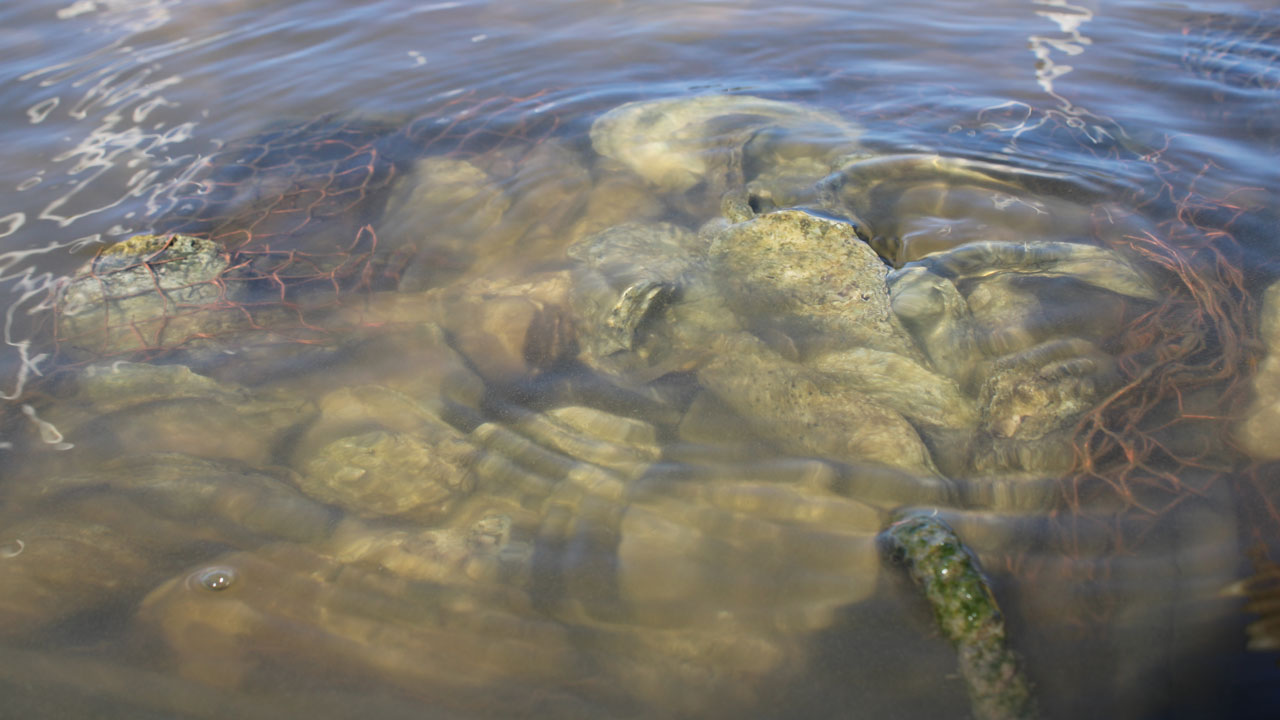
The photos below are from the Lightning Point oyster reef restoration project led by the Smee Lab. The first photo shows the layout of the oyster reef. The reef is created with bagged oyster shell. This gives the oysters somewhere to settle. The reefs are created in two parts. First a layer of bagged oyster shell. That is then topped with bags of oyster shell that have baby oysters settled onto them. These presettled bags of oyster shell take about a month of preparation before they go into the field. Dr. Smee’s lab monitors the oyster restoration projects to see how the presettled oysters are doing. The Lightning Point oyster reef was established in 2023.
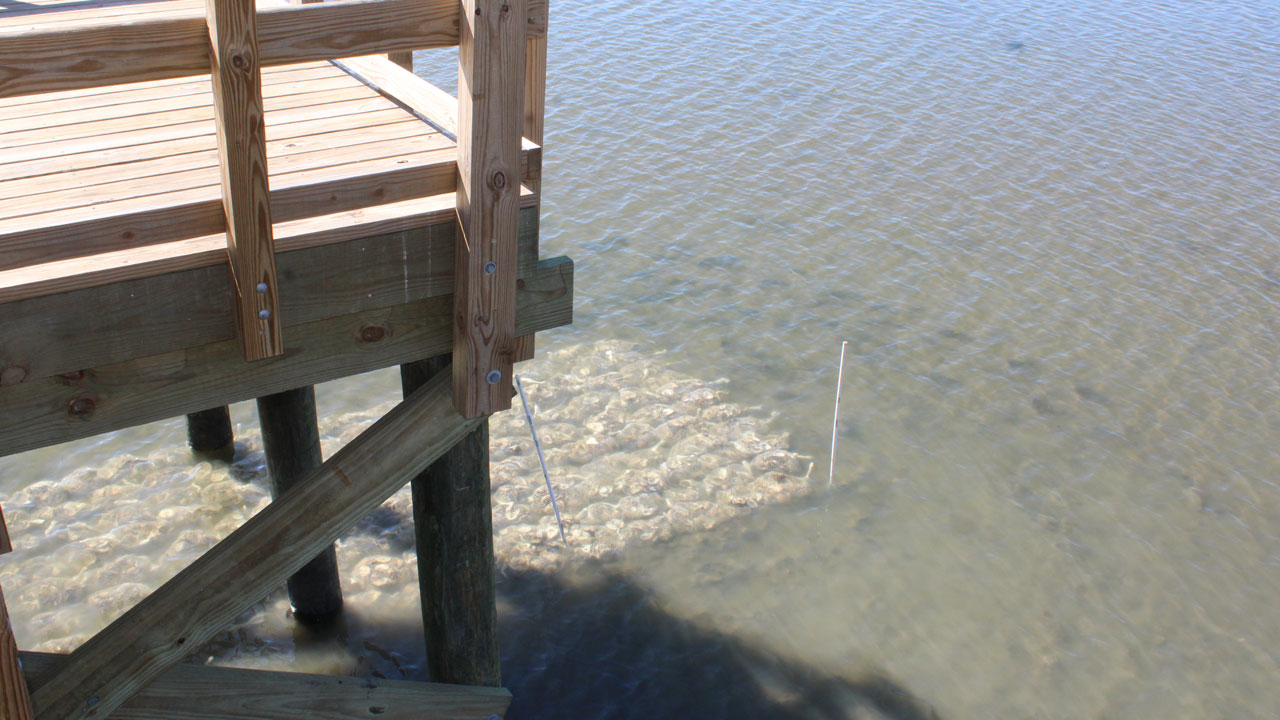
Dr. Smee’s lab recently created a similar restored oyster reef at the Blankenship Ecotourism Park on Dauphin Island in March of 2026. The last photo shows this project, and you can see it person when you go to the park.
Transcript
Angela Levins, DISL PR Director Welcome to the latest edition of our Sea Lab sidebar. And this morning I am joined by Christa Russell, who is a PhD candidate from the University of South Alabama. Good morning.
Christa Russell, PhD Candidate, DISL/University of South Alabama Good morning. How are you? I’m doing great. How are we doing this morning? Wonderful.
Levins We’re going to chat this morning about oyster restoration and how we, the people can be a part of this. So give us a quick background on oyster restoration.
Russell So oysters are these incredibly important organisms in our ecosystems. So they provide all of these things called ecosystem services, which we can talk about. We restore oysters both to help habitats, make sure that those oysters are there and they’re healthy, but also to support people. So we have one of the largest fisheries of oysters on the planet in the Gulf Coast. So it’s really important that these systems stay healthy so that they can keep us healthy, keep us fed, and keep us economically stable.
Levins When we talk about oyster restoration, where do we start? What’s the foundation?
Russell So when we talk about oyster restoration, I think the foundation is understanding where we have these healthy reefs that can grow and support themselves without us needing to interfere. There used to be very large areas of healthy, healthy oyster reef all over the Gulf Coast. And for a lot of reasons, we’ve lost those. So I think the intention behind restoration, at its most basic, is trying to get that footprint back so that these oysters don’t need us to keep adding and keep supporting them. They can do that on their own. As you’re drafting an oyster reef, what are you starting with? Are so oysters need something hard to settle on in order to survive. Unlike maybe a clam or some other bivalves that people are used to seeing, these guys can’t move once they settle, so they have to pick a good spot. And that good spot is oyster shell. They’ve evolved to know the taste of adult oyster shell. If you think about it, if an oyster grows to adulthood in a place, that means that place must be good enough to support an adult oyster. So the babies are very good at finding where their parents have been and staying there, knowing it’s a good place to be. So we start with substrate, either shell material or other type of hard material like concrete. In places like the Gulf Coast, we have challenges with enough larvae or baby oysters naturally in the water. So we often will also supplement that shell with new baby oysters that we’ve settled in a hatchery and then a nursery to give them that little head start.
Levins How long does it take for an oyster to go from larvae which don’t? Isn’t that called spat?
Russell So oysters have an interesting life cycle, so you wouldn’t think it from looking at an oyster. It looks kind of like a rock, but I swear it’s alive on the inside, right? Um, when they spawn, those larvae are planktonic. What that means is they’re very, very small and they’re free floating. You need a microscope to see them. And when they first start out as larvae, they can’t crawl. They just swim using their cilia. I think they look like little drunk bumblebees. I think they’re lovely. Um, when they’re about eleven to fourteen days old, they grow a foot and they get that urge to settle. They’re trying to find a new home so they’ll sink to the bottom. They find those dark places and start crawling around with that foot, find a nice spot and start building the sticky component of their shell. That stickiness of that outer shell actually binds to the substrate or to the hard bottom, and then they’ll start growing. But once they’ve picked a spot, they can’t necessarily move again, right? So they have to find that good spot that’s about two weeks olds. And then for the next, say six months or so, we consider them a spat for the first month or so. And they’re very, very small. So spat are those newly settled larvae that have just started to build a shell on a substrate in the Gulf Coast, where it’s really warm. We have lots of food in our water. We can harvest adult size oysters within a year, but in places where the water is cold, like the east coast or the west Coast, which is cold and potentially doesn’t have the same sorts of nutrients available. Also, another oyster species, those oysters, can take over four years to reach market size. So it really depends on the warmth of the water and what kind of resources are available. Our bay is a beautiful place for oysters to grow. I know it looks like chocolate milk, but oysters love that.
Levins Is it because of the salinity changes that happen within the mobile Bay area?
Russell Yeah. So oysters are an estuarine species, and that means they like these places where freshwater and saltwater meet. Fresh and salt water mixing are really, really high nutrient systems. If you think about it, as water moves across a landscape, as it flows into streams and then into bays and then into oceans, it’s carrying nutrients from the land with it. And so those areas are really, really productive. Those nice, shallow, warm areas are also excellent places for algae to grow. And that is oysters favorite thing to eat. They’re filter feeders. So they are feeding off of those well supported algae. And those algae are supported by the nutrients coming from all of that freshwater flow mixing with salt water.
Levins So we use all of that information in order to create an oyster reef. How do you find the place for an oyster reef?
Russell So something that restoration practitioners learned a long time ago is instead of trying to decide what makes a good oyster reef, ask nature. Right. We look for places where oysters could do well, but they just need a little bit of a leg up and needs human intervention to build enough substrate and start a reef that’s big enough to help support itself on its own, where it can produce enough of its own larvae to reseed itself and spread. So make sure that the adults are actually reproducing, producing new young. And those young are settling. So you have succession and multiple generations of oysters, and also that there are enough of them that they’re protected from all of the predators in our systems that could otherwise overtake a very small population. Nature gives you that spot that you can have. An oyster reef tells you that this is the place to be.
Levins Give us an idea of how many baby oysters and oyster shells, you might need to build a reef. Just one project that y’all have done that you can kind of number out of your head. Sounds great.
Russell So every project is a little bit different. I think that’s another important part of understanding how restoration works is there’s not one blueprint. Every place is a little bit different and every project needs something slightly different. It’s important for us to understand what the outcome of a potential project is. But as an example, let’s talk about an intertidal reef we built a few years ago. It’s in an area down by Lightning Point and outside of Bayou La Batre, Alabama. And that area used to have very large reef areas. There’s been a lot of restoration in that area, but there aren’t large healthy oyster reefs anymore. So we wanted to put down a base layer of shell, give them somewhere to grow, because a lot of the substrate there, the bottom is covered in sand, which isn’t what oysters need. They need something hard. We put down about twelve tons or so of oyster shell, which sounds like a lot. It’s funny how far that doesn’t go. When you go to put it in the water, it is a relatively large area. Um, but we use about twelve tons of oyster shell. Um, we actually recycle all our oyster shell from one of the oyster processing plants outside of Bayou La Batre. As we’re harvesting oysters, that shell is a resource, right? And right now a lot of it gets thrown away. So instead of putting that into the waste stream, we’re making sure that we’re taking that shell and putting it back where it came from to help support these new reefs. We then source our juvenile oysters, our larvae from the Auburn Shellfish Laboratory, which happens to be very conveniently right across the street down at the Sea Lab. They grow our larvae for us. It’s kind of wild. The larvae that we set, we set about eighteen million of them at a time. Which sounds like a crazy, crazy number. But keep in mind, these are larvae. They’re very, very small. So those eighteen million larvae are come to me in a little damp coffee filter all wrapped up. So they stay nice and moist and they’ll fit in the palm of my hand. They look like coffee grounds. And that’s eighteen million larvae. And if you think about it, if those were to go out onto, say, an aquaculture farm, each one of those is going to sell for at least a dollar. It’s kind of a wild feeling knowing you’re holding like eighteen million dollars worth of oysters in the palm of your hand. So we settle those baby oysters into our mesocosm tanks, which is just a big tank that mimics natural environments. We grow them out at the lab for between two weeks and a month, just to make sure they get big enough that they get past that initial stage where everything eats them because they’re small and fragile, and then we move them out and place them onto the reef. And that’s another about twelve tons of oyster shell that is bagged, settled with millions and millions of babies, and then placed out into the wild. And at that point, it’s kind of it’s hard being an oyster, mom, because you coddle them and love them for a month, and then you have to put them out in nature and just hope for the best. We do monitor them, of course, but there’s not a lot we can do. Once they’re out. It’s up to them at that point.
Levins Oyster mom, do you name them?
Russell I mean, it’s probably hard to come up with eighteen million names if I name them all Nemo kind of situation. Gotcha. Well, Christa, we’re going to wrap up our conversation on oyster reef restoration. But the conversation with you is not over because y’all have done a whole series of research on how to make sure that those oysters that you set out there stay alive.
Levins And that’s really cool. So we’re going to have you back so we can chat about that part of it. But thank you for sharing information about oyster reef restoration in general. Thank you so much for having me. I’m excited to come back and talk to you. And for the people listening, don’t toss your oyster shells because there are places that you can recycle them. And we’re going to give you a link on our website for you to do that.
Russell Yeah. The Alabama Coastal Foundation recycles oyster shell all over the bay. And there’s so many uses for oyster shell.
Levins So we’ll make sure you get that information. Christa. Thank you again and we’ll chat soon. Thanks.