 Apple Podcasts
 Spotify
 YouTube
 iHeart
The Sea Lab Sidebar is your quick dive into the science, people and discovery shaping our gulf. Join us as we explore the research and stories happening every day at the Dauphin Island Sea Lab.
Living shorelines enhance coastlines by using the natural environment to protect against erosion and rising waters. PhD Candidate Aaron Bland from Dr. Ron Baker’s lab chats about living shorelines and his research.
Project Greenshores Interactive Website
Dr. Ron Baker’s lab developed an interactive website using Project Greenshroes in Pensacola Bay, Florida to show how living shorelines can help reduce these impacts by stabilizing the coastal edge and enhancing fisheries’ biodiversity.
Project Greenshores began in the early 2000s to restore oyster reefs and create new salt marsh and seagrass habitats along Pensacola Bay. The project has created 50 acres of oyster reef and marsh habitat to date. Dr. Baker and his team dissect the project to show the habitats created and the fisheries’ biodiversity it supports.
The website was built with a grant from the Pensacola and Perdido Bays Estuary Program.
Breakwaters
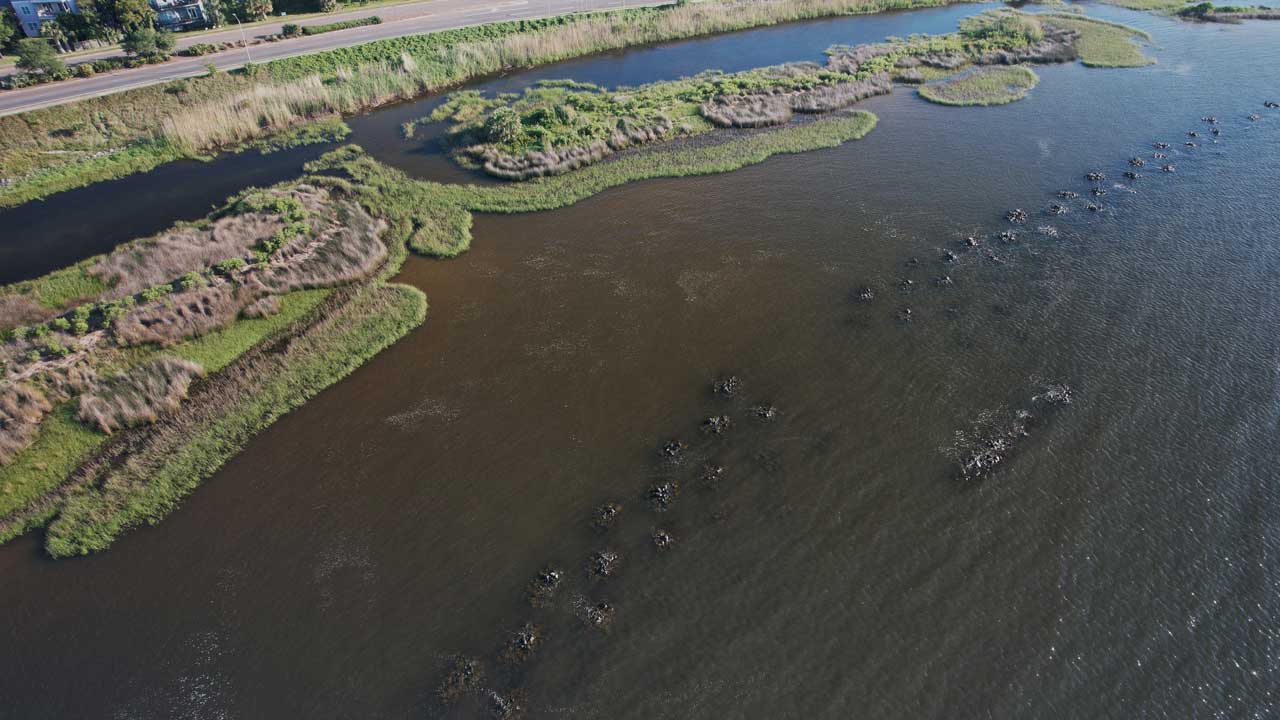
This photo shows the layout of the Project Greenshores living shoreline. The breakwaters are visible along the marsh edge. These structures help to reduce wave action.
Transcript
Welcome to the Sea Lab Sidebar. Your quick dive into the science, people and discoveries shaping our goal. Join us as we explore the research and stories happening every day at the Dauphin Island Sea Lab.
Angela Levins, PR Director Joining us today, we have Aaron Bland in Doctor Ronny Baker’s lab, who is a PhD candidate who’s going to chat with us about living shorelines. Aaron thank you for joining us.
Aaron Bland, PhD Candidate, Baker Lab Happy to be here.
Levins Let’s start out very briefly. What is a living shoreline?
Bland Well a living shoreline basically is a concept to protect our shorelines using natural habitats. Those natural habitats are often going to involve vegetation in our area. That would be saltmarsh as vegetation that likes to grow at the shoreline. And in our system, we’re also usually looking at shorelines that need some sort of defense from incoming wave energy. And the natural habitat that’s really good at protecting our shorelines would be oyster reefs.
Levins So natural environment, which means it’s its environment that would naturally occur in an area that you’re looking at.
Bland Exactly. Here in mobile Bay, in Portersville Bay, in coastal Alabama, our natural coastlines are pretty much characterized by inundated intertidal saltmarsh vegetation. So these are plants that grow in brackish water not too salty, not too fresh. They spend some amount of time during their day in the water and some amount of their day outside of the water. These plants can grow really quickly under those conditions. They grow really large root masses, which are really good at pulling that sediment together and grow long, tall, flexible stems, which are really good at resisting wave energy and softly dissipating it as waves crash over them.
Levins How can an oyster reef factor into a living shoreline?
Bland Oyster reefs historically occurred pretty commonly in our estuaries, including close to shore. They can grow as reefs, being hard substrates that are either just below the water surface or stick out of the water surface, and unlike all the soft mud that surrounds them, these hard oyster reefs can reflect wave energy before it hits the shore. And so in that sense, they protect the shore. Much like these days, we build artificial structures known as breakwaters, which tend to be large rocks or concrete or similar. But we place those into water in the water to intercept wave energy, whereas oyster reefs are sort of nature’s natural breakwaters.
Levins We talk about the intertidal marshes that can create the living shoreline environment and the oyster reefs. So now let’s talk about why the importance of these type of substrates to help with the defense of the shoreline.
Bland So there are a few interrelated issues that we see happening in our coastal environment. We talk about shoreline erosion, which is the loss of sediment, the loss of mud and sand that really forms the the ground that we stand on and build on. Then there’s also the idea of shoreline retreat, where the sea is advancing, landward that threatens our roadside structures and our homes and our businesses. And it’s also a threat to our natural habitats, like these coastal salt marshes. So shoreline defense describes a variety of strategies we use to defend that shoreline, to keep that shoreline in place and keep it the sea from encroaching on land.
Levins What about the sustainability of a living shoreline?
Bland Living shorelines can be thought of as a sort of a more modern alternative to traditional shoreline defense. So earlier I mentioned you can put a breakwater, large mound of rubble, rock, or concrete in the water to intercept waves at the shoreline. You could do something similar. You can erect a wall like a seawall or a bulkhead. You can lay down rocks over your shoreline that’s in a slope that’s called a revetment. So these are ways of either breaking wave energy before it hits the shore or holding your shoreline in place. But think about what that looks like over the long run. So we know that sea levels are rising. So eventually each of these structures is going to be drowned under rising sea levels. Now contrast that with salt marshes and oyster reefs. So we’re talking about living habitats, plants that are growing and not only growing, but they’re grabbing onto sediment floating in the water, and they’re adding biomass and leaf litter to the marsh platform. And in this way, they allow the marsh platform, the sediment that they’re growing on to grow vertically, to accumulate sediment and grow in pace with sea level rise. And as for the oyster reef, oysters are doing the same things. Since oysters are living animals, they produce babies that grow on top of each other. Non-Living shell is incorporated into the reef, and in this way, oyster reefs can also grow vertically in pace with sea level rise. So this is what we focus on when we say living. Shoreline habitats can be more sustainable than non-living structures which cannot grow vertically.
Levins So I think that’s a huge takeaway from it. You’ve wrapped it up perfectly, is that a living shoreline grows with the changes in an environment?
Bland Yeah, that’s a good way to put it. And even if living shorelines cannot grow quite that quickly, there’s still more responsive to environmental hazards than non-living structures. So we talk about hurricane damage, for instance. So when a hurricane smashes a homeowner’s bulkheads, they’re looking at costly repairs. When a hurricane smashes a coastal saltmarsh, it might also be damaged, but the tendency is for that saltmarsh to recover on its own, for plants to consolidate that sediment and grow back to where it was once before. I guess to wrap up with everything, your living shoreline is the ability to protect with your natural habitat and grow with what’s there. And so I guess it just depends really on the environment that you’re looking at with the living shoreline.
Levins So what is your big takeaway that you want people to walk away with in our chat today about living shorelines.
Bland So in my research, in my lab’s research, we are surveying and investigating a variety of living shorelines in coastal Alabama. And we’re measuring all sorts of things about how they perform, how they perform in protecting the shoreline and some of these other ecosystem services that they provide, like what kind of fish make their home at these breakwaters, or what sort of critters do we find growing in the mud at these sites? Since we’re interested in these dual benefits of shoreline defense and other ecosystem services. And what we find is that these projects really run the range of performance. So some are really effective at protecting the shorelines and some not so effective. There’s a lot of nuance into when living shorelines might be suitable, what effects they’ll have on their environment and how exactly they are implemented that affect their performance in a variety of ways. It’s hard to make a general recommendation on where and how living shoreline should be done, because we find that it really depends on where you are.
Levins So, Aaron, that’s great because that goes right along with what we do here at the Sea Lab, which is creating the science to help with the best possible policy and management of our coastal waterways. Anything else that you’d like to add?
Bland Yeah. So next time you’re at the coastline, you might take a look around and see what’s in your environment. Is it a natural environment? Do you see engineered structures in your environment? And think about what processes are happening at your coastline and what our interventions are doing to your environment? Is it becoming the environment that you want your coastline to be?
Levins Aaron, thank you so much for joining us and chatting about living shorelines and your research and what you’ve learned. We appreciate it.
Bland Of course, anytime.